
SpaceShipOne’s splendid achievments have me re-visiting the days of my youth, when the most remarkable video I had ever seen was the jerky footage taken from a modified V-2 rocket as it lifted off some time after the war — Walter Kronkite used this footage as the introduction to the CBS documentary series ‘Twentieth Century.’ You would see the launching pad dwindling below, then the scrub desert not all that far from where SpaceShipOne flew, and as the flight progressed, just a glimpse of a stunningly curved horizon that told you how far into the unfathomable black you had traveled.
 How exciting the future looked in those days, as I followed the flights of the X-15, a rocket vehicle whose altitude record SpaceShipOne exceeded today. I began to puzzle over the question of nostalgia for a future that never happened, an odd notion that makes me think of all the dreams we as a culture have assigned to the future at different times in our history. Then along comes a fine essay called “The Tomorrow That Never Was,” by Henry Jenkins in the October 1 issue of MIT Technology Review. Jenkins talks in particular about the film Sky Captain and the World of Tomorrow, as well as a graphic novel called In the Shadow of No Towers, both of which use what he refers to as ‘retro-futurism’ to deliver their message.
From Jenkins:
Just as we can now go back and read the popular culture of the late 1930s for its traces of an America on the eve of a world war, future historians will be able to read these images as displacements of early twenty-first century concerns but mapped onto an imaginary world where gum-chewing boy geniuses, dapper young pilots, plucky ‘female reporters,’ and dashing British commanders can overpower anything the terrorists throw at us.
And later, this:
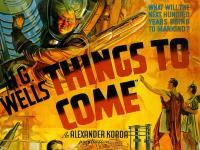
Sky Captain doesn’t just bring old images of technological wonders to life; it also captures the technophilia that shaped those glistening images. Go back and watch a movie like Things to Come (1940). The film stops dead for five minutes or more so we can take pleasure in showering sparks, pounding pistons, and spinning gears. Technology of the 1930s was sleek, sensuous, and sexy. According to the prevailing myths, government and corporate efforts were leading to steady improvements in the quality of life, urban planners were already designing the cities of the future, and what happened next was constrained only by the limits of the public’s energy and imagination. Everyone anticipated better and better tomorrows.
Be sure to read the whole thing here (free registration may be needed to see it). And ponder whether the gritty, inward-looking science fiction of the cyberpunk era and later hasn’t short-changed the tremendous powers of the human imagination. Writers like Robert Sawyer now talk about the corpus of science fiction, occasionally stimulated to a pseudo-life by admittedly talented authors, thrashing about like a dying man getting electro-shocks to the heart. If it really is dying, perhaps that is because science fiction has so sharply limited its horizons in its obsession with the idiosyncratic rather than the universal, with inner rather than outer space. We all know that the dark challenges we face are real, but there should remain a place for constructive dreaming that seems largely unfilled today, at least in the pages of a once vibrant genre.

0 Comments