
And it’s not a brown dwarf, either. That’s the verdict of astronomers using the Keck II and Gemini North telescopes (supported by observations at Kitt Peak National Observatory), who have been studying a binary system with a difference. One of the stars involved has lost huge amounts of mass, enough that it no longer qualifies as
a star. We do not, in fact, know what to call it.
“Like the classic line about the aggrieved partner in a romantic relationship, the smaller donor star gave, and gave, and gave some more until it had nothing left to give,” says Steve B. Howell, an astronomer with Wisconsin-Indiana-Yale-NOAO (WIYN) telescope and the National Optical Astronomy Observatory, Tucson, AZ. “Now the donor star has reached a dead end – it is far too massive to be considered a super-planet, its composition does not match known brown dwarfs, and it is far too low in mass to be a star. There’s no true category for an object in such limbo.”
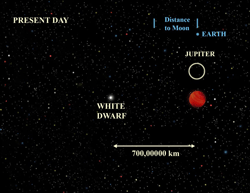
Image: EF Eridanus 500 Million Years Ago. Onset of mass transfer some 500 million years ago when the donor object (right), began losing mass to the compact yet more massive white dwarf companion (left). At the time of this illustration, the star system appeared much brighter in optical light than it does today. Illustration by Jon Lomberg/Credit: Gemini Observatory.
The system, EF Eridanus, is located about 300 light years from Earth. The star in the system is a white dwarf with approximately 60 percent of the mass of the Sun; it is a burnt-out stellar remnant about as big as the Earth, and it is still producing light. The inert object — whatever we choose to call it — has 1/20th the mass of the Sun, and is now roughly the diameter of Jupiter. The two objects are separated by about the same distance as the Earth and the Moon.
“There are about 15 other known binary systems out there that may be similar to EF Eri, but none has been studied enough to tell,” Howell says. “We are working on some of them right now, and trying to improve our models to better match the infrared spectra.”
Source: National Optical Observatory, Tucson. More at this Keck Observatory page.

0 Comments