
David Ardila’s work with the debris disk around the star HD 107146, covered in these pages on the 8th, has been complemented by new findings from the Spitzer Space Telescope. While Ardila’s team surveyed a young Sun-like star whose debris disk was relatively thick, the Spitzer study looked at six stars whose age approximates the Sun, about 4 billion years old. The disks around such stars are 10 to 100 times thinner than those around young stars.
The Spitzer study scanned 26 Sun-like stars with known planets, ranging from 50 to 160 light years away; six of them showed debris much like our Sun’s Kuiper Belt. Dr. Charles Beichman of the Jet Propulsion Laboratory is lead author of the study. “Young stars have huge reservoirs of planet-building materials,” Beichman said, “while older ones have only leftover piles of rubble. Hubble saw the reservoirs and Spitzer, the rubble. This demonstrates how the two telescopes complement each other.”
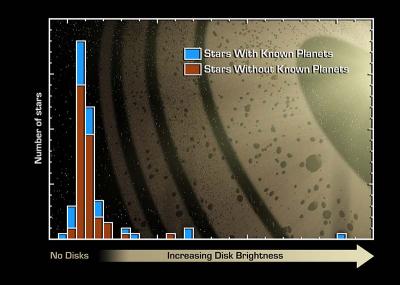
Image: This graph of data from NASA’s Spitzer Space Telescope indicates that stars with known planets (blue) are more likely to have “debris disks” than stars without known planets (red). Spitzer sampled 84 stars, 26 with and 58 without known planets. Of the 26 planet-bearing stars, six had disks; of the 58 stars without planets, six had disks. The presence of these debris disks was inferred from the amount of excess infrared light measured at a wavelength of 70 microns, relative to that emitted by the parent star. While most of the observed stars have a ratio near unity, indicating that the 70-micron light is coming from the star itself, several stars show a high degree of excess emission. It is these stars that are surrounded by Kuiper Belt-like debris disks. Credit: NASA/JPL-Caltech
Debris disks are significant because rocky planets are believed to form out of clouds of dust that surround young stars, their particles colliding and sticking together until rocky objects eventually form. Collisions between the larger objects create vast disks of debris whose centers are empty, cleared out by planets orbiting there. The Hubble images of HD 107146 showed such a gap in the disk, and so did the six disks studied by Beichman. Astronomers at Hawaii’s W.M. Keck Observatory had previously found a disk surrounding the red dwarf AU Microscopii, a young star located 32 light years away. JPL astronomer John Krist recently used Hubble to image the gap in that disk.
From a news release from the Space Telescope Science Institute (Baltimore, MD):
“Spitzer has established the first direct link between planets and discs,” Beichman said. “Now, we can study the relationship between the two.” These studies will help future planet-hunting missions, including NASA’s Terrestrial Planet Finder and the Space Interferometry Mission, predict which stars have planets. Finding and studying planets around other stars is a key goal of NASA’s exploration mission.
The Spitzer findings will be published in the Astrophysical Journal.


0 Comments