
The Japan Aerospace Exploration Agency’s Hayabusa spacecraft (formerly known as MUSES-C) is demonstrating the advantages of ion propulsion in its mission to land on the asteroid Itokawa and return samples of its surface to Earth in 2007. When it performed an Earth flyby in May, Hayabusa became the first spacecraft to accomplish such a maneuver using an ion engine as its main thruster. In cruise mode, the craft’s four ion engines were designed to burn throughout the flight. JAXA’s recent announcement that Hayabusa’s engines had marked 20,000 hours of ‘accumulated operational time’ points out the ion advantage: the spacecraft’s engines consumed a mere 20 kilograms of propellant during that time. You can see the JAXA news release here.
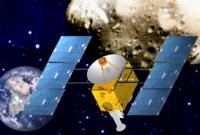 Ion engines operate continuously for long periods because their thrust levels are low, but their high efficiency makes them ideal for deep space missions. Hayabusa uses ionized xenon gas sent through a strong magnetic field and expelled at high speed as the source of its thrust. These are the same principles that drove NASA’s Deep Space 1, which was the first to use an operational ion drive in space (although unlike Deep Space 1, Hayabusa uses microwaves to ionize its fuel).
Hayabusa is to arrive at Itokawa (named after the founder of Japan’s space program) in June of 2005, spending five months nearby in a heliocentric orbit; the choice of landing sites will be made after the mission team examines images made during that time. If all goes well, scientists will be able to collect samples from three different sites on Itokawa; a small robot called Minerva will be used to explore the surface.
JAXA offers a Hayabusa exploration page here.

0 Comments