
If we’re looking for an operational solar sail mission that is within our current capabilities — as Colin McInnes discusses in the quote from his book in yesterday’s entry — GEOSTORM seems just the ticket, and indeed, McInnes has contributed significantly to its design and orbital dynamics. The mission was first conceived at Goddard Space Flight Center and proposed to the National Oceanic and Atmospheric Administration (NOAA) in the 1990s. NOAA requested a mission concept study from the Jet Propulsion Laboratory in 1996.
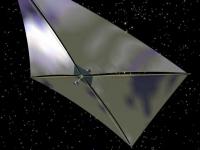 GEOSTORM is conceived as a warning system for geomagnetic storms, which are the result of violent events that release plasma from the solar corona. Predicting them is important because they can affect satellite communications and damage geostationary spacecraft, as well as wreaking havoc with power grids on Earth. But GEOSTORM is also a mission that could advance the state of the art in solar sails as we look toward future deep space missions, including probes to the near interstellar medium outside the heliosphere.
Already, non-sail satellites like the Advanced Composition Explorer (ACE), launched in 1997, have proven useful in providing solar wind data. ACE flies in a ‘halo’ orbit around the L1 Lagrange point some 1.5 million kilometers Sunward from the Earth. L1 is a natural point of equilibrium where the gravitational forces of the Sun and the Earth are in balance. This allows a stable position for ACE with a continuous view of the Sun.
GEOSTORM would move significantly closer to the Sun, thus providing much better monitoring of solar activity and longer warning times for geomagnetic storms. But stabilizing the payload well Sunward of the L1 point at suborbital speeds is something only a solar sail can do. That seems to fit McInnes’ notion of “…a small, low-cost and low-risk solar sail mission for which there is either no feasible alternative form of propulsion or no alternative option of comparable cost” quite nicely.
Significantly, GEOSTORM would require sail technologies that are now on the shelf. The sail would not be huge, on the order of 67 meters to the side. As for materials, McInnes says that the sail concept “…allows the use of commercially available 7.6 µm Kapton film for the sail substrate, and does not require the manufacture of specialized thin films.” (McInnes, Solar Sailing: Technology, Dynamics and Mission Applications (Chichester UK: Springer/Praxis, 1999), p. 233).
What’s ahead for GEOSTORM? Before any operational mission can fly, we need to evaluate thrust performance, attitude control, structural dynamics and a host of other issues in Earth orbit. You can view NASA’s 15-year solar sail roadmap here. Also be aware of Inflatable Structures Taking to Flight, an article in Aviation Week & Space Technology, available on the Web site of solar sail researcher L’Garde. A useful backgrounder on NASA solar sail work is An Overview of NASA’s Solar Sail Propulsion Project, by Gregory Garbe and Edward Montgomery (PDF warning).
0 Comments