
Most readers of Centauri Dreams will be familiar with SETI@home, the huge distributed computing project that taps the power of millions of PCs to process data from the Arecibo radio telescope. Distributed computing offers vast amounts of processing power, and it’s the cornerstone of a new project called Einstein@home, which has been created to apply the same kind of computing muscle to the study of gravitational waves.
The Laser Interferometer Gravitational Wave Observatory (LIGO) is behind this project, which will launch in February. Part of Einstein’s general theory of relativity includes the prediction that gravity waves should permeate the universe. Researchers at LIGO are looking for hard data to prove the prediction, using sites in Louisiana and Hanford, WA. You an read more about the background of the project in this Nature.com article. A fine backgrounder on gravitational waves is available here.
What exactly is LIGO looking for? A cosmic source that creates regular waves of gravitational energy. From the Einstein@Home Web site:
Gravitational waves are ripples in the fabric of space and time produced by events in our galaxy and throughout universe, such as black hole collisions, shockwaves from the cores of exploding supernovas, and rotating pulsars, neutron stars, and quark stars. These ripples in the space-time fabric travel toward Earth, bringing with them information about their origins, as well as invaluable clues to the nature of gravity.
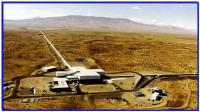 For the purposes of the study, the most likely sources would be dense, rapidly rotating stars such as neutron stars or the still more elusive quark stars. Some of these objects may not be precisely spherical, which could lead to their emitting significant gravitational waves.
Image: LIGO’s Hanford WA facility. Credit: Laser Interferometer Gravitational Wave Observatory.
And like the SETI search, the problem is that vast amounts of data need to be combed through to find the possibly significant vibration that really is a gravitational wave rather than interference. LIGO needs supercomputing-style power and simply doesn’t have it, which is where the resources of millions of networked machines come into play.
Interesting to see that Einstein@Home has enlisted the help of David Anderson, who developed the SETI@Home software — the latter project has provided computing power far in excess of any supercomputer ever built to the study of extraterrestrial radio sources.
Gravitational Wave Detection with Atom Interferometry
Authors: Savas Dimopoulos, Peter W. Graham, Jason M. Hogan, Mark A. Kasevich, Surjeet Rajendran
(Submitted on 8 Dec 2007)
Abstract: We propose two distinct atom interferometer gravitational wave detectors, one terrestrial and another satellite-based, utilizing the core technology of the Stanford $10 \text{m}$ atom interferometer presently under construction. The terrestrial experiment can operate with strain sensitivity $ \sim \frac{10^{-19}}{\sqrt{\text{Hz}}}$ in the 1 Hz – 10 Hz band, inaccessible to LIGO, and can detect gravitational waves from solar mass binaries out to megaparsec distances. The satellite experiment probes the same frequency spectrum as LISA with better strain sensitivity $ \sim \frac{10^{-20}}{\sqrt{\text{Hz}}}$. Each configuration compares two widely separated atom interferometers run using common lasers. The effect of the gravitational waves on the propagating laser field produces the main effect in this configuration and enables a large enhancement in the gravitational wave signal while significantly suppressing many backgrounds. The use of ballistic atoms (instead of mirrors) as inertial test masses improves systematics coming from vibrations and acceleration noise, and reduces spacecraft control requirements.
Comments: 5 pages, 5 figures
Subjects: General Relativity and Quantum Cosmology (gr-qc); Astrophysics (astro-ph); High Energy Physics – Phenomenology (hep-ph); High Energy Physics – Theory (hep-th); Atomic Physics (physics.atom-ph)
Cite as: arXiv:0712.1250v1 [gr-qc]
Submission history
From: Surjeet Rajendran [view email]
[v1] Sat, 8 Dec 2007 04:32:38 GMT (312kb)
http://arxiv.org/abs/0712.1250
Cosmic explosion, but no gravitational waves
LIGO looks at its first gamma-ray burst
http://physicsworld.com/cws/article/news/32461