
Here’s an image of the possible Martian pack ice, taken by Mars Express’ High Resolution Stereo Camera (HRSC), which is imaging the entire planet in full colour, 3-D and with a resolution of about 10 metres. The 3-D capability allows us to see Martian topography in unprecedented detail. Look here for other extraordinarily detailed images.
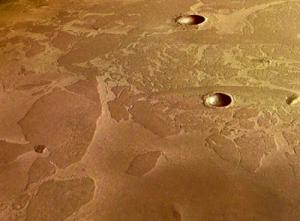 This image, taken by the High Resolution Stereo Camera (HRSC) on board ESA’s Mars Express spacecraft, during orbit 32, shows what appears to be a dust-covered frozen sea near the Martian equator. It shows a flat plain, part of the Elysium Planitia. The scene is a few tens of kilometres across, centred on latitude 5º North and longitude 150º East. Credits: ESA/DLR/FU Berlin (G. Neukum)
Meanwhile, findings from Mars Express were discussed in a news conference on the 25th. To say the session was packed with news is an understatement: we have not only the possible pack ice but discussions of Martian methane and formaledhyde and their significance for the hunt for life, as well as much on volcanic and geological activity (some of it evidently recent, according to ESA). The six instruments on Mars Express have had quite a year. You can read more on what each has discovered in this ESA press release.
Also announced at the session were the results of a poll of many of the 250 Mars experts present. 75 percent of them said no when asked whether life could be present on Mars today, though when asked whether life might once have existed on the Red Planet, 75 percent said yes. The above image — and the presence of methane in the atmosphere — remain provocative. Surely the demand for a sample return mission will continue to grow.

Model Methanogens
http://www.spaceref.com/news/viewpr.nl.html?pid=22816
“University of Arkansas researchers have tested the
methane production of three different types of
microorganisms in different soil types that resemble
those found on Mars to test the possibility of these
soils harboring life.”
April 23, 2009
Life Beyond Earth in 10 Years or Less?
Written by Anne Minard
Illustration credit: Robert McCall
Peter Smith feels pretty certain we’ll be finding life on Mars within the next decade.
Smith, the University of Arizona professor who led NASA’s Phoenix Mars Mission, made his predictions to a spellbound audience during a lecture at the University of Delaware earlier this month, and he discussed his ideas by phone on Thursday.
He carries a “sense of optimism” about finding life on Mars, he said, because of the tantalizing clues Phoenix sent to Earth.
“Finding life on Mars would be one of the great discoveries of all time,” he said. “We’re not that far away. The next mission could be the one.”
Full article here:
http://www.universetoday.com/2009/04/23/life-beyond-earth-in-10-years-or-less/
May 20, 2009
A Benevolent Sort of Asteroid Bombardment?
Written by Anne Minard
Celestial impacts can bring life as well as wipe it out, say the authors of a new study out of the University of Colorado at Boulder.
A case in point: the bombardment of Earth nearly 4 billion years ago by asteroids as large as Kansas would not have had the firepower to extinguish potential early life on the planet and may even have given it a boost.
In a new paper in the journal Nature, Oleg Abramov and Stephen Mojzsis report on their study of impact evidence from lunar samples, meteorites and the pockmarked surfaces of the inner planets. The evidence paints a picture of a violent environment in the solar system during the Hadean Eon 4.5 to 3.8 billion years ago, particularly through a cataclysmic event known as the Late Heavy Bombardment about 3.9 million years ago.
Although many believe the bombardment would have sterilized Earth, the new study shows it would have melted only a fraction of Earth’s crust, and that microbes could well have survived in subsurface habitats, insulated from the destruction.
“These new results push back the possible beginnings of life on Earth to well before the bombardment period 3.9 billion years ago,” Abramov said. “It opens up the possibility that life emerged as far back as 4.4 billion years ago, about the time the first oceans are thought to have formed.”
Full article here:
http://www.universetoday.com/2009/05/20/a-benevolent-sort-of-asteroid-bombardment/
Needless to say, this is good news for the chances of life appearing and surviving
on other planets throughout the Universe. Whether they eventually evolve enough
to create their own version of the Internet is another matter.
Reconciling methane variations on Mars
06 Aug 2009
Since the discovery of its presence in the Martian atmosphere, methane has remained an intriguing atmospheric component which source (either of biotic or abiotic origin) is not yet fully understood. The recently reported variations in the concentration of atmospheric methane have proven difficult to explain with 3-D numerical models of the atmosphere that include the known chemical and physical processes.
In a paper published this week in Nature, Franck Lefèvre and François Forget present their study to derive the implications of the observed methane concentrations on Mars and their variability.
They conclude that there needs to be both an intense localised source of methane and a destruction mechanism that is much more efficient than the known atmospheric processes that break down methane.
Further, if this efficient destruction of methane occurs only close to the surface, these findings imply a very harsh environment for organic molecules to survive on the surface of Mars.
Full article here:
http://sci.esa.int/science-e/www/object/index.cfm?fobjectid=45382
Mars, methane, and mysteries
10 August 2009
Mars may not be as dormant as scientists once thought. The 2004 discovery of methane means that either there is life on Mars, or that volcanic activity continues to generate heat below the martian surface. ESA plans to find out which it is. Either outcome is big news for a planet once thought to be biologically and geologically inactive.
http://www.esa.int/esaCP/SEMB9OE3GXF_index_0.html
December 8, 2009
New Findings Say Mars Methane Comes from Life or Water — or Both
Written by Nancy Atkinson
A new paper that will be published Wednesday rules out the possibility that methane is delivered to Mars by meteorites, boosting the idea that the short-lived gas perhaps could be generated by either life or water, or maybe even both.
Microorganisms living in the Martian soil could be producing methane gas as a by-product of their metabolic processes, or methane might be created as a result of reactions between volcanic rock and water. Either way, the prospect is exciting.
Methane on Mars was first detected in 1999, again in 2001 and 2003, which was widely reported, but not much was known about the origin or amount of the gas on Mars.
In January 2009, scientists analyzing data from telescopic observations and unmanned space missions announced that the methane on Mars is being constantly replenished by an unknown source and they are keen to uncover how the levels of methane are being topped up.
Full article here:
http://www.universetoday.com/2009/12/08/new-findings-say-mars-methane-comes-from-life-water-or-both/