
Sometimes the fuzziest image carries a sense of awe that later, far more detailed photographs do not quite convey. Such were the early photographs from the Palomar Observatory showing planetary images that forever fixed in my mind the dream of seeing these places up close; even Cassini’s extraordinary views can’t eclipse the memory of Palomar’s Saturn as seen through a boy’s eyes forty-five years ago. And it may be that the image below carries a bit of the same awe.
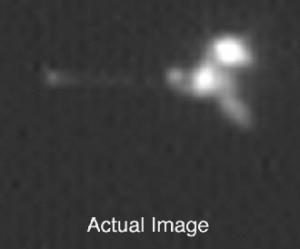 Fuzzy it may be, but you’re looking at an image of the Mars Odyssey spacecraft as seen by another craft, the Mars Global Surveyor using its Mars Orbiter Camera. This and another Mars Orbiter Camera image, that one of the European Space Agency’s Mars Express spacecraft, mark the first time a spacecraft in orbit around another planet has taken pictures of another spacecraft orbiting that planet. You can compare the actual image of Mars Odyssey with the computer-generated view of the spacecraft below to interpret what you’re seeing.
Image (above): This view is an enlargement of an image of NASA’s Mars Odyssey spacecraft taken by the Mars Orbiter Camera aboard NASA’s Mars Global Surveyor while the two spacecraft were about 90 kilometers (56 miles) apart. The camera’s successful imaging of Odyssey and of the European Space Agency’s Mars Express in April 2005 produced the first pictures of any spacecraft orbiting a foreign planet taken by another spacecraft orbiting that planet. Image and caption credit: NASA/JPL/MSSS.
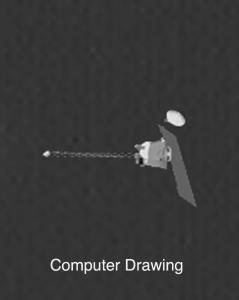 Mars Orbiter Camera can resolve Martian features down to a few meters across from the Mars Global Surveyor orbit (350 to 405 kilometers). The image of Mars Odyssey is taken from about 90 kilometers. Both craft are in nearly circular near-polar orbits, with Odyssey in a slightly higher orbit; the craft occasionally close to within as little as 15 kilometers. Malin Space Science Systems, JPL, and the Mars Global Surveyor operations teams (Lockheed Martin Space Systems, Denver) obtained the images in April.
There is something that sends a tingle up the spine about seeing human technology viewing itself, and the mind is immediately drawn back to the image of the Huygens probe as it departed the Cassini Saturn Orbiter back in December. Our probes are machines driven by computers and the complex commands of long-range communications. Ultimately, they must become fully autonomous as we push past the outer Solar System and into interstellar space. In a deep sense, their design is a legacy of the curiosity and aspirations of a technological civilization.
More photos from the Mars Orbiter Camera, including its view of Mars Express, can be found at the Malin Space Science Systems site.


0 Comments