
The Hubble Space Telescope, in operations designed to support the upcoming New Horizons mission to Pluto, has discovered two new Plutonian moons. It’s too early to speak with confidence about their size because we don’t yet know to what extent light reflects from their surfaces, but the early estimates are for diameters of 32 kilometers (20 miles) and 70 kilometers (45 miles). Charon, at 1200 kilometers, dwarfs these tiny objects, provisionally designated S/2005 P1 and S/2005 P2. Their faintness makes it clear why they weren’t spotted before: the new moons are roughly 5000 times fainter than Pluto itself. For more, see this Southwest Research Institute news release.
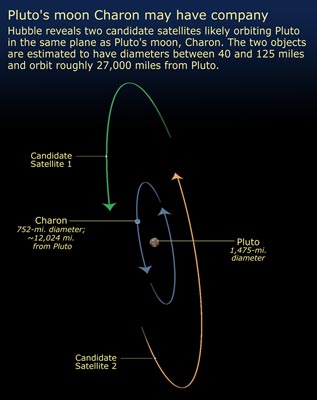
“Our result also suggests that other bodies in the Kuiper Belt may have more than one satellite. We planetary scientists will have to take these new moons into account when modeling the formation of the Pluto system,” says co-leader Dr. Alan Stern, executive director of the SwRI Space Science and Engineering Division. And yes, that’s the Alan Stern who is principal investigator for the New Horizons mission, which also made the news yesterday. Its Atlas 5 rocket, we now learn, suffered minor damage from hurricane Wilma on the 24th of October even though it was shielded inside a construction hanger at Cape Canaveral. The winds tore holes in the hanger’s door, but the 450-kilogram probe was not attached to the rocket at the time, and the January launch date seems unlikely to slip much, if at all.
Image: Pluto’s newly discovered moons in their orbits some 43,000 kilometers from the planet. Credit: NASA, ESA, and A. Feild (STScI).
On the new Plutonian moons, Centauri Dreams‘ take is this: We have essentially two models for planetary formation going on at Pluto. One says that a massive collision created Charon, and by extension the two tiny companion objects. The other model is that the smaller moons were simply captured from their earlier orbits in the Kuiper Belt. The latter argument is compelling because we have evidence for other captures, especially Neptune’s moon Triton, that seem to be an inevitable result of the complexity of the Kuiper Belt swarm interacting with the outer planets. New Horizons will doubtless provide more clues upon arrival.

0 Comments