
Looking at the beautiful swirl of a spiral galaxy, it’s hard to imagine how much we’re not seeing. But current studies indicate that dark matter in a typical galaxy outweighs the stars in it by ten to one. That’s the conclusion of astronomer Michael Strauss (Princeton), who has been working on how the dark matter halos of such galaxies cluster. Combine those calculations with the visible information provided by quasars and you can say something about the mass of the halos.
This is fascinating work indeed, using Sloan Digital Sky Survey data that reveal quasar superclusters divided by vast regions of empty space. The quasars themselves are bright concentrations of gas falling into supermassive black holes at the center of galaxies. And it’s clear they’re embedded in massive concentrations of dark matter. Says Strauss:
“We can’t observe the dark halos directly, but we know from theoretical calculations how they should cluster with one another. By measuring the clustering of the quasars, we can infer the masses of the ‘halos’ in which they live.”
And the result is that the brightest quasars are found in the most massive halos, halos that are several trillion times the mass of the Sun. The image below gives an idea of the distribution of this material.
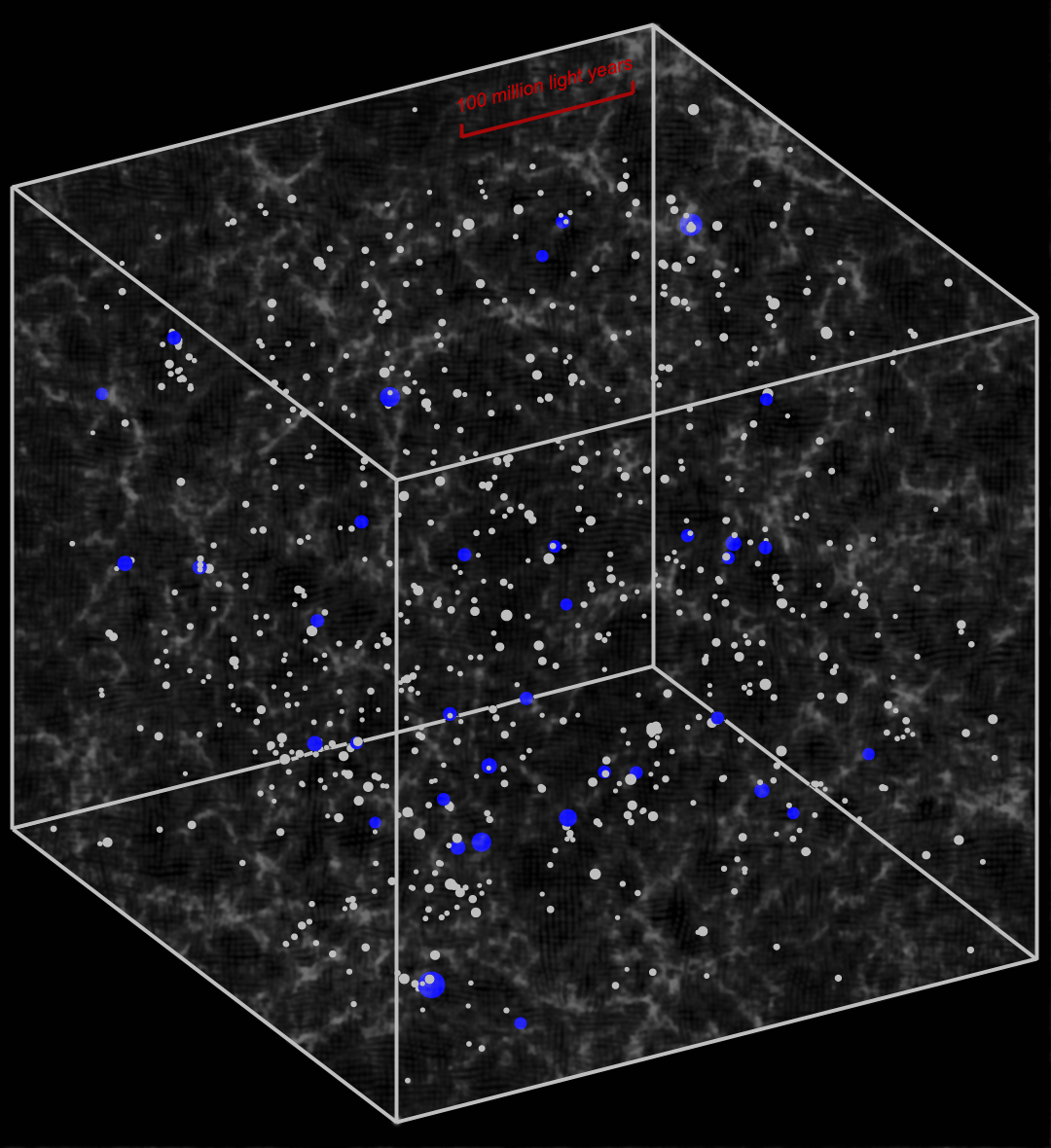
Image (click to enlarge): The distribution of dark matter, massive halos, and luminous quasars in a simulation of the early universe, shown 1.6 billion years after the Big Bang. Gray-colored filamentary structure shows the distribution of “invisible” dark matter. Small white circles mark concentrated “halos” of dark matter more massive than 3 trillion times the mass of the sun. Larger, blue circles mark the most massive halos, more than 7 trillion times of the sun, which host the most luminous quasars. The strong clustering of the quasars in the SDSS sample demonstrates that they reside in these rare, very massive halos. Credit: Paul Bode and Yue Shen, Princeton University.
Strauss and Princeton graduate student Yue Shen used 11 billion light years as their minimum distance sample, allowing them to show the structure of the universe at an early age. But think about the enigma we’re still dealing with. Where did the supermassive black holes that make quasars possible come from? Here’s Harvard’s Avi Loeb (not a part of the SDSS study) on this perplexing issue:
“The existence of bright quasars at early cosmic times is one of the unsolved mysteries of cosmology. How did black holes grow to a billion times the mass of the sun when the universe was only a tenth of its current age? The SDSS measurements will help us answer this question.”
Let’s hope so, because it’s a big one. The paper is Shen et al., “Clustering of High Redshift (z > 2.9) Quasars from the Sloan Digital Sky Survey,” accepted by The Astronomical Journal and available online as a preprint.
0 Comments