
Putting the General Theory of Relativity to the test gives us a chance to look once again at Einstein’s understanding of gravity to see how it conforms with reality. We know the theory is incomplete because it doesn’t tell us what happens to gravity at the subatomic level. But on the macro-scale of the larger universe, General Relativity is again confirmed in new work involving an unusual pair of neutron stars.
The work, performed by an international team using the Jodrell Bank telescope in Cheshire and the Green Bank instrument in West Virginia, examined two pulsars that orbit each other, the only known case out of some 1700 identified pulsars where two are found in such a configuration. Emitting beams of radio waves, the two stars offer another observational opportunity — their orbital plane lines up nearly with their line of sight to Earth. The result: An eclipsing signal as one pulsar moves behind the ionized gas surrounding the other. The fortuitious lineup makes possible an extremely accurate measurement.
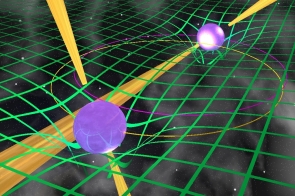
Victoria Kaspi (McGill University) calls this system “…precisely the kind of extreme ‘cosmic laboratory’ needed to test Einstein’s prediction.” Extreme is an understatement — we’re talking about the shattered remains of massive stars, objects the size of Cleveland that stream radio waves from the poles of their intense magnetic fields, recorded from our vantage as stuttering signals that match a rotation of up to hundreds of times a second.
Image: The illustration shows the two pulsars which orbit the common centre of mass in only 144 minutes. The system was discovered by astronomers from the University of Manchester as part of an international team in 2003 and it is the eclipses observed in this system that have lead to this study. Credit: Michael Kramer, University of Manchester.
Einstein’s theory tells us that when two massive objects are paired in a close system like this, the gravitational pull of one should cause the spin axis of the other to wobble. Earlier studies have demonstrated the effects of such wobbling (precession), but relativistic effects become more significant the larger and closer the objects under investigation are, making this the most accurate measurement of its magnitude. Changes to the spin axis of these pulsars appeared as changes to the signal blockages during the eclipse events, offering an exquisitely precise check on General Relativity’s predictions.
Says René Breton (McGill University):
“Pulsars are too small and too distant to allow us to observe this wobble directly, However, as they orbit each other every 145 minutes, each passes in front of the other and the astronomers soon realized they could measure the direction of the pulsar’s spin axis as the highly magnetized region surrounding it blocks the radio waves being emitted from the other. After patiently collecting the radio pulses over the past four years, they have now determined that its spin axis precesses exactly as Einstein predicted.”
Both Jodrell Bank and Green Bank are storied sites in the history of astronomy. Have the two observatories now confirmed General Relativity beyond all question? The answer is that again and again, Einstein’s work holds up to the tests being thrown at it. Both Newton and Einstein ‘work,’ but Einstein works better in a larger range of environments. And just as Einstein significantly extended Newton (making sense, for example, of anomalies in the Newtonian explanation for Mercury’s orbit), so we push on today to extend Einstein’s theory into the quantum realm, a search that is one of the most significant in modern physics.
This appears to be a measurement of the Geodetic Effect. This is the effect that the curvature of space-time has on spinning bodies. There is another much more subtle effect called Frame-dragging which is the effect that a spinning massive body has on other spinning bodies, due to “dragging” space-time while spinning. Note that NASA’s Gravity Probe B has also confirmed the existence and magnitude of the Geodetic effect down to <1.5% precision and has been collecting data to study the Frame-dragging effect but the team has not yet been able to fully analyze that data (and it’s possible their instrument is not accurate enough to detect Frame-dragging unambiguously).
Next on NOVA: “Einstein’s Big Idea”
http://www.pbs.org/wgbh/nova/einstein/
Tuesday, September 16 at 8 p.m.
(Check your local listings as dates and times may vary.)
E = mc2 was just one of several extraordinary breakthroughs that
Einstein made in 1905, including the completion of his special
theory of relativity, his identification of proof that atoms exist,
and his explanation of the nature of light, which would win him the
Nobel Prize in Physics.
Among Einstein’s ideas, E = mc2 is by far
the most famous. Yet how many people know what it really means? In
the thought-provoking and engrossing docudrama
“Einstein’s Big Idea,” NOVA illuminates this deceptively simple
formula by unraveling the story of this program traces the stories
of how it came to be.
Here’s what you’ll find on the companion Web site:
The Legacy of E = mc2
http://www.pbs.org/wgbh/nova/einstein/legacy.html
Einstein’s big idea has been enormously influential, in ways
that reach far beyond the purely scientific.
E = mc2 Explained
http://www.pbs.org/wgbh/nova/einstein/experts.html
Hear how 10 top physicists describe the equation in a few
minutes or less.
The Producer’s Story
http://www.pbs.org/wgbh/nova/einstein/producer.html
Filmmaker Gary Johnstone describes how creativity fuels both art
and science.
The Power of Tiny Things
http://www.pbs.org/wgbh/nova/einstein/tiny.html
How much energy does a paper clip pack? Test your intuition in
this quiz.
The Equation Today
http://www.pbs.org/wgbh/nova/einstein/today.html
Three young physicists contemplate how a 100-year-old equation
figures into their careers.
Ancestors of E = mc2
http://www.pbs.org/wgbh/nova/einstein/ancestors.html
Meet the visionary scientists whose experiments paved the way
for Einstein.
Einstein the Nobody
http://www.pbs.org/wgbh/nova/einstein/bodanis.html
The patent clerk’s career prospects looked bleak just before his
“miracle year” of 1905.
Einstein Quotes
http://www.pbs.org/wgbh/nova/einstein/wisdom.html
Seven thought-provoking statements from the world’s most famous
scientist
The Theory Behind the Equation
http://www.pbs.org/wgbh/nova/einstein/kaku.html
Explore the eureka moment when Einstein came up with special
relativity, the theory that spawned E = mc2.
The Light Stuff
http://www.pbs.org/wgbh/nova/einstein/hotsciencelight/
Find out why the speed of light isn’t always 186,000 miles per
second.
Genius Among Geniuses
http://www.pbs.org/wgbh/nova/einstein/genius/
To rank with Newton or Einstein, you have to reinvent the way we
see the world.
Time Traveler
http://www.pbs.org/wgbh/nova/einstein/hotsciencetwin/
Explore time dilation in this interactive version of Einstein’s
“twin paradox.”
Relativity and the Cosmos
http://www.pbs.org/wgbh/nova/einstein/relativity/
Examine what many consider Einstein’s greatest achievement–
general relativity.
Einstein Time Line
http://www.pbs.org/wgbh/nova/einstein/timeline/
Follow the arc of Einstein’s life from his birth in 1879 till
his death in 1955.
Also, Links & Books, the Teacher’s Guide, the program transcript,
and more:
http://www.pbs.org/wgbh/nova/einstein/
Gravitational waves in the Hyperspace?
Authors: Christian Corda, Giorgio Fontana, Gloria Garcia Cuadrado
(Submitted on 5 Jan 2009 (v1), last revised 8 Jan 2009 (this version, v2))
Abstract: In the framework of the debate on high-frequency gravitational waves (GWs), after a review of GWs in standard General Relativity, which is due for completness, the possibility of merging such a traditional analysis with the Hyperspace formalism that has been recently introduced in some papers in the literature, with the goal of a better understanding of manifolds dimensionality also in a cosmological framework, is discussed.
Using the concept of refractive index in the Hyperspace, spherical solutions are given and the propagation of GWs in a region of the Hyperspace with an unitary refractive index is also discussed. Propagation phenomena associated to the higher dimensionality are proposed, possibly including non-linear effects. Further and accurate studies in this direction are needed.
Comments: Accepted for publication by Modern Physics Letters A. In the new version the references have been updated
Subjects: Astrophysics (astro-ph)
Cite as: arXiv:0901.0458v2 [astro-ph]
Submission history
From: Christian Corda [view email]
[v1] Mon, 5 Jan 2009 10:43:34 GMT (7kb)
[v2] Thu, 8 Jan 2009 06:31:01 GMT (7kb)
http://arxiv.org/abs/0901.0458
On the role of the Michelson-Morley experiment: Einstein in Chicago
Authors: Jeroen van Dongen
(Submitted on 11 Aug 2009)
Abstract: This article discusses new material, published in Volume 12 of the Collected Papers of Albert Einstein, that addresses Einstein’s knowledge of the Michelson-Morley experiment prior to 1905: in a lecture in Chicago in 1921, Einstein referred to the experiment, mentioned when he came upon it, and hinted at its influence.
Arguments are presented to explain the contrast with Einstein’s later pronouncements on the role of the experiment.
Comments: Archive for History of Exact Sciences, in press
Subjects: History of Physics (physics.hist-ph)
DOI: 10.1007/s00407-009-0050-5
Cite as: arXiv:0908.1545v1 [physics.hist-ph]
Submission history
From: Jeroen van Dongen [view email]
[v1] Tue, 11 Aug 2009 17:22:43 GMT (172kb)
http://arxiv.org/abs/0908.1545
A New Challenge to Einstein?
by Sean of Cosmic Variances
General relativity, Einstein’s theory of gravity and spacetime, has been pretty successful over the years. It’s passed numerous tests in the Solar System, scored a Nobel-worthy victory with the binary pulsar, and gets the right answer even when extrapolated back to the first one second after the Big Bang.
But no scientific theory is sacred. Even though GR is both aesthetically compelling and an unquestioned empirical success, it’s our job as scientists to keep probing it in different ways. Especially when it comes to astrophysics, where we need dark matter and dark energy to explain what we see, it makes sense to put Einstein to the most stringent tests we can devise.
So here is a new such test, courtesy of Rachel Bean of Cornell. She combines a suite of cosmological data, especially measurements of weak gravitational lensing from the Hubble Space Telescope, to see whether GR correctly describes the behavior of large-scale structure in the universe. And the surprising thing is — it doesn’t. At the 98% confidence level, Rachel finds that general relativity is inconsistent with the data.
I’m not sure why we haven’t been reading about this in the science media or even on other blogs — it’s certainly a newsworthy result. Admittedly, the smart money is still that there is some tricky thing that hasn’t yet been noticed and Einstein will eventually come through the victor, but this is serious work by a respected cosmologist. Either the result is wrong, and we should be working hard to find out why, or it’s right, and we’re on the cusp of a revolution.
Here is the abstract:
A weak lensing detection of a deviation from General Relativity on cosmic scales
Authors: Rachel Bean
Abstract: We consider evidence for deviations from General Relativity (GR) in the growth of large scale structure, using two parameters, ? and ?, to quantify the modification. We consider the Integrated Sachs-Wolfe effect (ISW) in the WMAP Cosmic Microwave Background data, the cross-correlation between the ISW and galaxy distributions from 2MASS and SDSS surveys, and the weak lensing shear field from the Hubble Space Telescope’s COSMOS survey along with measurements of the cosmic expansion history. We find current data, driven by the COSMOS weak lensing measurements, disfavors GR on cosmic scales, preferring ? < 1 at 1 < z < 2 at the 98% significance level.
Full article here:
http://blogs.discovermagazine.com/cosmicvariance/2009/10/12/a-new-challenge-to-einstein/