
Two studies stand out in the list of Phase 1 awards recently announced by NASA’s Institute for Advanced Concepts (NIAC). Gerald Jackson of Hbar Technologies (Chicago) will work on “Antimatter Harvesting in Space,” while James Bickford of Draper Laboratory (Cambridge, MA) will study “Extraction of Antiparticles Concentrated in Planetary Magnetic Fields.” Both offer solutions to the huge antimatter production problem that currently has us extracting tiny amounts at fantastic price from particle accelerators here on Earth.
Jackson’s is a familiar name. He and Steve Howe at Hbar are well known in the antimatter community as proponents of a fascinating and evidently feasible antimatter sail concept that would be energized by minute amounts of antihydrogen (see this earlier Centauri Dreams story). Jackson’s new work on antimatter harvesting suggests taking antimatter collection into space, snaring antiprotons produced by the collision of cosmic rays with dust and solar wind protons.
“Just as in certain mathematical problems wherein the product of two variables respectively approaching infinity and zero can yield a finite number, the harvesting of antimatter in our solar system can produce finite and significant quantities given a big enough net,” writes Jackson in a precis of the study now available at the NIAC site (PDF warning). “The challenge is to envision a revolutionary capture and delivery architecture that generates a sufficient return on investment.”
Both Jackson and Bickford take a shot at this; Jackson’s would use concentric wire spheres as an electromagnetic trap, with the outermost sphere positively charged to repel protons from the solar wind while attracting anti-protons, which bear a negative charge. The particles would then be collected in the innermost sphere.
Bickford’s idea is to use a magnetic scoop to extract antiprotons trapped within planetary magnetic fields. He estimates that 10 micrograms of antiprotons and 10 milligrams of positrons are contained within the Earth’s magnetosphere at any given time. Significantly larger quantities should be found in the radiation belts of the Jovian planets. The collector involved is an adaptation of an idea first proposed by Robert W. Bussard for interstellar propulsion, in this case an electromagnetic scoop attached to a satellite in planetary orbit.
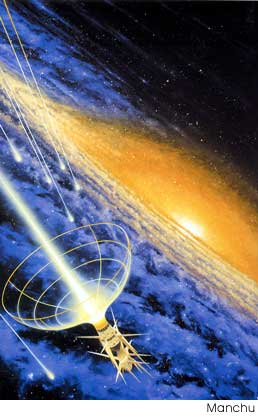 Image: An electromagnetic scoop first appears in interstellar studies as a Bussard ‘ramjet,’ capable of fantastic speeds, but now thought unfeasible because of drag constraints. New proposals, however, use magnetic scoop technology to mine space-borne antimatter. Credit: ESA/ITSF; Manchu.
Each Phase 1 NIAC study receives $75,000 for a six month period in which to prove the viability of the concept and identify the obstacles that must be overcome to make the proposal a reality. A limited number of NIAC studies then receive Phase II funding. The complete list of the current Phase 1 proposals is available here. And in case you missed it, here is a good Washington Post story by Joel Achenbach from May 15 that covers commercial activity in space, with a sidebar on NIAC.

0 Comments
Trackbacks/Pingbacks