
The Cassini Saturn orbiter will make its closest approach yet to Titan tomorrow, traveling 1200 kilometers (745 miles) above the surface at a speed of 6.1 kilometers per second. This will be the first time Cassini has used its radar instruments to image the moon. Confirmation that data from the flyby were successfully received won’t come in until evening (6:30 PM PDT) on the 26th.
 A close look at the imaging and radar data will be fascinating in itself, but this flyby is also a crucial part of the attempt to land the Huygens probe on Titan, an event now scheduled for January 14, 2005 (with separation of the lander from Cassini on Christmas day). A prime objective is to determine whether the landing area for the probe is solid or liquid in nature.
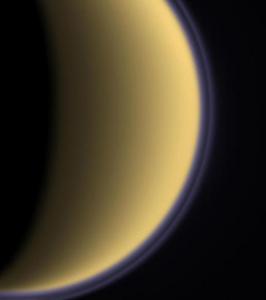
Image: Encircled in purple stratospheric haze, Titan appears as a softly glowing sphere in this colorized image taken one day after Cassini’s first flyby of that moon. Credit: NASA/JPL/Space Science Institute.
Says professor Michele Dougherty of Imperial College, lead scientist for the magnetometer instrument on Cassini, “Titan’s atmosphere is similar to the very early atmosphere of the Earth and by studying its properties we can start to unravel some of the mysteries of the planet. The Cassini Magnetometer experiment will investigate Titan’s interior and variations in the magnetic field measurements could indicate the presence of an ocean contaminated by salty materials like in the Earth’s oceans and in the hypothesised oceans of Callisto and Europa in the Jovian System.”
The Huygens lander — and Cassini itself — are vivid reminders of the importance of autonomous systems. Consider the flight software Huygens will use to deploy its parachutes for the descent to Titan’s surface next January. Produced by a British company called LogicaCMG, the software will need to deploy Huygens’ chutes, separate the front and back shields precisely on time, maintain a pre-determined descent profile that will reduce Huygens’ velocity before beginning its scientific experiments, and manage spacecraft-to-spacecraft communications with Cassini. All this with round-trip radio communications delays that preclude any help whatsoever from controllers on Earth.
And Titan is positively next door compared to an interstellar destination. Robotic systems that can maintain a space vehicle and conduct science for decades at a time will be needed before we ever consider launching a probe to the nearest star, which is one reason why artificial intelligence and autonomy loom large in the thinking of deep space theorists. Huygens is a fascinating and necessary early step in that direction.
Cassini’s closest approach to Titan is at 9.44 am PDT. The first downlink occurs at approximately 6.30 pm PDT; NASA TV coverage will run from 6.30 pm to midnight PDT. Check here for updates to NASA TV scheduling. And here is the primary Cassini-Huygens mission page. Sources: press release from the Particle Physics and Astronomy Research Council (UK); various NASA Web pages.

0 Comments