
The possibility that a near-Earth asteroid might strike the planet in 2029 has now been ruled out. Asteroid 2004 MN4 had attained press prominence when it emerged that the 400 meter object would pass near the Earth on April 13, 2029, with the odds on impact rising to 1 in 300. That alone made for the kind of story the media love to flog, but the reality all along was that new data about the asteroid’s orbit would probably rule out the possibility of impact.
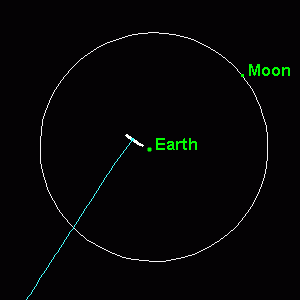 And that is just what has happened, thanks to the work of Jeff Larsen and Anne Descour of the Spacewatch Observatory near Tucson, Arizona. By studying archival images of the object, they were able to extend the observational time available to scientists, improving knowledge of the orbit of 2004 MN4 enough to fix its position in space in 2029. The final position is shown in the diagram, with alternate positions ranging through the white line that intersects the projected orbit of the asteroid. It’s a close call, but not a disastrous one. You can look at a risk analysis for 2004 MN4 at the Near Earth Object Program site.
Centauri Dreams‘ take: Near-Earth asteroids (NEAs) are unlikely short-term threats but likely long-term ones. In other words, the longer we wait, the more likely an impact will eventually occur. As an advocate of long-term thinking, Centauri Dreams would prefer to look out 100,000 years, and not rest complacent with the thought that we’re probably safe for the next hundred. In any case, these objects are tricky; the orbit of 2004 MN4 itself will be altered by its near-earth encounter, leading to less certainty about its future position post 2029.
All of this makes the development of a space-based infrastructure extending into the outer Solar System a simple matter of species survival. If 2004 MN4 had been shown to be a likely candidate for impact, could today’s technology stop it? The best place to deflect such threat is the furthest possible distance from Earth, when a small nudge can have big orbital consequences. We’ll need to be able to travel those regions in the Solar System from which stray asteroids may emerge in plenty of time to nudge them into safer orbits, and that means continuing work on advanced methods of propulsion.
Image Source: Jet Propulsion Laboratory

0 Comments