
Hard on the heels of the recent Hubble photograph of 2003 UB313 comes further news on the size of this increasingly interesting object. While Hubble showed that the newly discovered ’10th planet’ was only slightly larger than Pluto (and therefore smaller than originally thought), a German team has now provided further data suggesting that the object has a diameter of about 3000 kilometers, roughly 700 kilometers larger than that of Pluto.
Measuring distant objects is tricky enough at Pluto’s distance, but 2003 UB313 can reach 97 AU at the most distant point in its orbit, almost twice as far as Pluto ever gets from the Sun. To get an accurate reading, astronomers must know something about the reflectivity of the object. But what Frank Bertoldi (University of Bonn and the Max-Planck-Institute for Radioastronomy) and Wilhelm Altenhoff (MPIfR) managed to do was to combine optical observations with heat measurements at a wavelength of 1.2 mm, where reflected sunlight is negligible. The astronomers believe the surface of 2003 UB313 reflects 60 percent of the light that strikes it from the Sun, a reflectivity similar to Pluto.
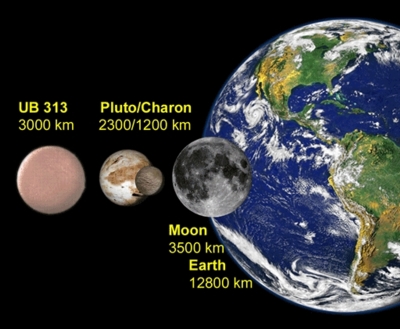
Image: Estimated size of 2003 UB313’s diameter based on the Bonn studies, and compared with that of the Pluto, Charon, Earth, and the Moon. Source: Max-Planck-Institute for Radioastronomy.
The Bonn work and the Hubble photograph seem to point to different conclusions, with the slightly smaller world suggested by Hubble being significantly more reflective than the somewhat larger, darker object painted by these thermal studies. It will be fascinating to watch further observations come together on a Kuiper Belt object that challenges our definition of the word ‘planet’. The paper is Bertoldi, Altenhoff et al., “The trans-neptunian object UB313 is larger than Pluto,” in Nature (February 2, 2006).

0 Comments