
Fine work by Rosetta on the Steins flyby. Check here for more imagery of the ‘diamond in the sky,’ with cratering suggesting extreme age.
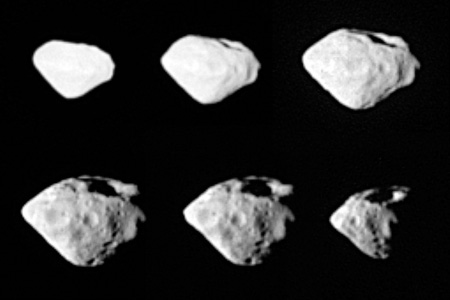
Image: Asteroid Steins seen from a distance of 800 km, taken by the OSIRIS imaging system from two different perspectives. The effective diameter of the asteroid is 5 km, approximately as predicted. At the top of the asteroid (as shown in this image), a large crater, approximately 1.5-km in size, can be seen. Scientists were amazed that the asteroid survived the impact that was responsible for the crater. Credits: ESA ©2008 MPS for OSIRIS Team MPS/UPM/LAM/IAA/RSSD/INTA/UPM/DASP/IDA.

According to the ESA website the camera went inexplicably into safe mode at the closest approach and the extreme close-up data wasn’t captured. They’re trying to figure out why the software misbehaved and how to rectify it – hopefully in time for the 21 Lutetia flyby in 2010. That asteroid is over 20 times bigger than little Steins and AFAIK the largest asteroid probed yet.
“Dawn”, the two asteroid orbiter mission, will be returning data from Ceres by the time Rosetta reaches its target comet. Apparently a post-primary mission possibility is a flyby of Pallas, which would be quite a catch – three of the largest Main Belt asteroids in one mission.
Lucy in the sky with diamonds….
Why were the scientists surprised that Steins has such a
large crater that indicated the space rock survived the
impact? I thought they already considered most planetoids
to be like swiss cheese.
Look at Mathilde which NEAR imaged in 1997: It has major
impact craters that should have meant the planetoid would
have been pulverized, but it is not.
Larry, looks like a pretty big whack for so small an object! But you’re right that we have other examples of such.
Doesn’t seem surprising to me that it would have a wide range of impact craters. Starting from its origin in the breakup of a much-larger body it would share similar orbital parameters as the other ejecta and would then have several billion years during which to play the game of interplanetary billiards. It would perhaps be more interesting if it had fewer craters since it would indicate its fairly recent formation during a collision event on a larger body, from which it would’ve been ejected. As it is, this asteroid must be fairly old. Just look at the Moon and other erosion-free bodies to see the affects of age in the solar system *outside* of the asteroid belts.
Europe plans asteroid sample grab
By Jonathan Amos
Science reporter, BBC News
Marco Polo is one of a number of competing ideas
European scientists and engineers are working on a potential new mission to bring back material from an asteroid.
The venture, known as Marco Polo, could launch in the next decade, and would be designed to learn more about how our Solar System evolved.
The plan is to select a small asteroid – less than 1km across – near Earth and send a spacecraft there to drill for dust and rubble for analysis.
Mission plans are being worked on by UK Astrium and OHB in Germany.
Both satellite manufacturers have been asked to undertake a feasibility study, to assess the type of spacecraft architecture that would be needed to carry out the project.
A final decision on whether to approve the mission will be made by the European Space Agency (Esa) in a few years’ time. The mission would launch towards the end of the next decade, in about 2017
Full article plus animation here:
http://news.bbc.co.uk/2/hi/science/nature/7623411.stm