
It’s good to see the European Space Agency’s ARIEL mission getting a bit more attention in the media. The Atmospheric Remote-sensing Infrared Exoplanet Large-survey was selected earlier this year as an ESA science mission, scheduled for launch in 2028. Here the goal is to cull a statistically large sample of exoplanets to examine their evolution in the context of their parent stars. Giovanna Tinetti (University College London) is principal investigator.

I would urge seeing ARIEL in the context of a different kind of evolution, that being the gradual growth in our technologies as we continue getting closer to studying the atmospheres of terrestrial-class worlds. For while ARIEL cannot achieve this feat — its focus is on exoplanets of Jupiter-mass down to super-Earths, all on close orbits, with temperatures greater than 320 Celsius — it leverages the fact that high temperature atmospheres keep their various interesting molecules in continual circulation, rather than letting them sink into obscuring layers of cloud. They are thus more easily detected and provide fodder for future work.
Image: Giovanna Tinetti (UCL), principal investigator for ARIEL.
The goal is to study hundreds of transiting exoplanets, looking at the spectra of their atmospheres as they pass in front of their host stars, allowing starlight to filter through the gaseous envelope for analysis. The light emitted by these atmospheres will also be analyzed just before and after the planets pass behind their primaries. Such transmission spectroscopy allows scientists to unlock the composition, temperature and chemical processes at work. No other spacecraft has been so tightly devoted to atmospheric analysis as ARIEL, and here we will be working with a large sample population in search of commonalities and differences. We go from just a few characterized atmospheres to hundreds.
I see that NASA is contributing fine guidance sensors in two photometric bands in an instrument called CASE — Contribution to ARIEL Spectroscopy of Exoplanets — which will observe clouds and hazes at near-infrared as well as visible wavelengths, complementing ARIEL’s other instrument, an infrared spectrometer that operates at longer wavelengths. It will be CASE that measures planetary albedo while examining how clouds influence the composition and other properties of the atmospheres under study. ARIEL should provide abundant insights into how future telescopes can home in on worlds much more like our own.
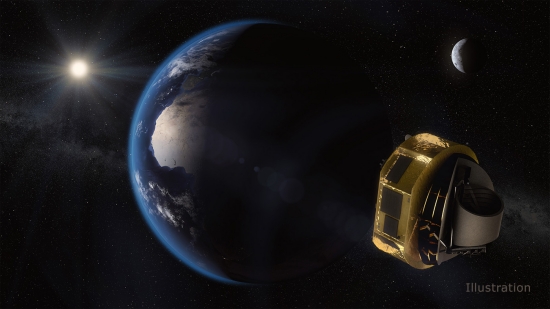
Image: This artist’s concept shows the European Space Agency’s ARIEL spacecraft on its way to Lagrange Point 2 (L2) – a gravitationally stable, Sun-centric orbit – where it will be shielded from the Sun and have a clear view of the sky. NASA’s JPL will manage the mission’s CASE instrument. Credit: ESA/STFC RAL Space/UCL/Europlanet-Science Office.
Remember that while we await the launch of the James Webb Space Telescope, JWST is by no means a dedicated exoplanet mission, though it will work with a small sample of exoplanets for detailed study as it shares observing time with other investigations. The ARIEL team should be able to draw from JWST’s experience as it homes in on a final target list. Keep in mind as well that ESA’s PLATO mission — PLAnetary Transits and Oscillations of stars — is also in the pipeline, slated for a 2026 launch. As I say, the tools are evolving as our focus sharpens.

There is a nice PDF ARIEL giving the details of the telescope and mission. I note that the design is made to determine whether these molecules are present:
H2O, CO2, CH4, CO, H3+, HCN, NH3, SO2, SiO, TiO, VO, C2H2, C2H4, C2H6, PH3 (fig 3.2, p18 of the document).
While the molecular coverage might just indicate early life, the lack of O2 detection will preclude the detection of a biosignature for an oxygenic photosynthetic world.
What would be needed for O2 and/or O3 detection? Are these oxygen molecules just too transparent to be detected by any means yet invented?
I think th e reason is that their NIR window doesn’t effectively cover the O2 a, or even O3 absorption peaks. I am not an expert, so perhaps someone else can wade in here.
In practice, we will be lucky to see any biosignatures as the target exoplanets are mostly going to be large, hot planets, although super-Earths are a possibility. Just no Earthlike worlds. :
Hi Alex, just came across a new paper that models Ozone (O3) around M and K dwarfs with some interesting conclusions;
Study Refines Which Exoplanets Are Potentially Habitable.
http://astrobiology.com/2019/11/study-refines-which-exoplanets-are-potentially-habitable.html
Habitability and Spectroscopic Observability of Warm M-dwarf Exoplanets Evaluated with a 3D Chemistry-Climate Model.
https://arxiv.org/abs/1907.10048
But according to the Ariel PDF article it looks like it does not have the capability to pick up the Ozone spectrum. It may be up to JWT and the giant ground scopes to observe this important feature.
The depletion of the Ozone layer from UV flaring around active M-dwarfs may not be as bad as indicated in the article, though. Recently an article mentions the higher impact rates from comets around these tightly wound M-dwarf planetary systems. The early active period of M-dwarfs may be countered in later life by the addition of large quantities of water from the much higher cometary impact rates. This would resupply the Ozone layer along with the surface based water supply. It will not be long till we find out if this question is so, the JWT should show if the Ozone layers are present around the numerous nearby M-dwarfs planets.
The other big feature of ARIEL – and something that will be vital to future biosignature detecting telescopes – is it’s ability to observe in mid/thermal infrared wavelength. A wavelength in which erstwhile exoplanets emit rather than reflect energy, thus revealing far more about its make up and atmosphere. ARIEL will do this via the use of “secondary” eclipses . As an exoplanet passes behind its parent star ( rather than in front with a “primary eclipse”) it’s emitted spectrum disappears . A simple deduction of the starlight during the eclipse from the combined planet/star just before reveals the emissive spectrum of the planet. The relative long wavelength and small number of planetary photons has limited this approach to low resolution for large and hot Jupiters to date . As it will with 1m aperture ARIEL. However larger telescopes -starting with 6.5m JWST – will (just) be big enough to employ this technique on smaller, cooler terrestrial planets such as those orbiting Trappist-1 . Just. As Paul alludes, incremental steps, with the ultimate goal of targeting terrestrial planets with terrestrial style atmospheres. In space likely via interferometry or hopefully sooner for M dwarf systems utilising the upcoming ELTs.
I came across an interesting FREE Astronomy magazine from Italy that is written in English. It has many in-depth articles on exoplanets and can be read in your browser online. There is also a site that has the PDF version for easy download.
Free Astronomy Magazine by Astro Publishing.
https://www.astropublishing.com/all_FAM.htm
PDF version.
http://www.cnyo.org/category/education/free-astronomy-magazine/
Thanks for posting this free astronomy magazine. So much to read, all the back issues.
Thanks Michael . An elegant publication pitched and described at just the right level. Makes great reading.