
Some three years ago, the Five-Hundred Meter Aperture Spherical Telescope (FAST) in Guizhou, China discovered a gas agglomeration that was later dubbed Cloud-9. It’s a cute name, though unintentionally so, as this particular cloud is simply the ninth thus far identified near the spiral galaxy Messier 94 (M94). And while gas clouds don’t particularly call attention to themselves, this one is a bit of a stunner, as later research is now showing. It’s thought to be a gas-rich though starless cloud of dark matter, a holdover from early galaxy formation.
Scientists are referring to Cloud-9 as a new type of astronomical object. FAST’s detection at radio wavelengths has been confirmed by the Green Bank Telescope and the Very Large Array in the United States. The cloud has now been studied by the Hubble telescope’s Advanced Camera for Surveys, which revealed its complete lack of stars. That makes this an unusual object indeed.
Alejandro Benitez-Llambay (Milano-Bicocca University, Milan) is principal investigator of the Hubble work and lead author of the paper just published in The Astrophysical Journal Letters. The results were presented at the ongoing meeting of the American Astronomical Society in Phoenix. Says Benitez-Llambay:
“This is a tale of a failed galaxy. In science, we usually learn more from the failures than from the successes. In this case, seeing no stars is what proves the theory right. It tells us that we have found in the local Universe a primordial building block of a galaxy that hasn’t formed.”
Here there’s a bit of a parallel with our recent discoveries of interstellar objects moving through our Solar System. In both cases, we are discovering a new type of object, and in both cases we are bringing equipment online that will, in relatively short order, almost certainly find more. We get Cloud-9 through the combination of radio detection via FAST and analysis by the Hubble space telescope, which was able to demonstrate that the object does lack stars.
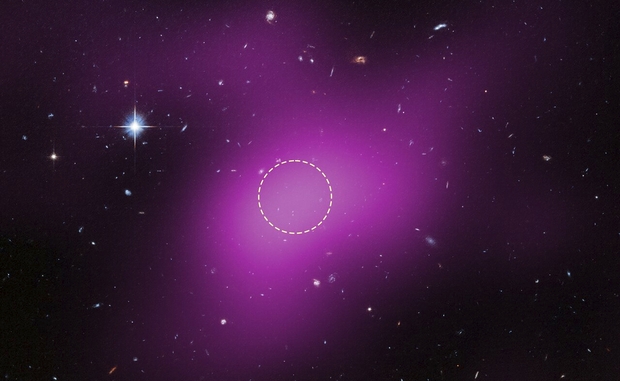
Image: This image shows the location of Cloud-9, which is 14 million light-years from Earth. The diffuse magenta is radio data from the ground-based Very Large Array (VLA) showing the presence of the cloud. The dashed circle marks the peak of radio emission, which is where researchers focused their search for stars. Follow-up observations by the Hubble Space Telescope’s Advanced Camera for Surveys found no stars within the cloud. The few objects that appear within its boundaries are background galaxies. Before the Hubble observations, scientists could argue that Cloud-9 is a faint dwarf galaxy whose stars could not be seen with ground-based telescopes due to the lack of sensitivity. Hubble’s Advanced Camera for Surveys shows that, in reality, the failed galaxy contains no stars. Credit: Science: NASA, ESA, VLA, Gagandeep IAnand (STScI), Alejandro Benitez-Llambay (University of Milano-Bicocca); Image Processing: Joseph DePasquale (STScI).
We can refer to Cloud-9 as a Reionization-Limited H Ι Cloud, or RELHIC (that one ranks rather high on my acronym cleverness scale). H I is neutral atomic hydrogen, the most abundant form of matter in the universe. The paper formally defines RELHIC as “a starless dark matter halo filled with hydrostatic gas in thermal equilibrium with the cosmic ultraviolet background.” This would be primordial hydrogen from the earliest days of the universe, the kind of cloud we would normally expect to have become a ‘conventional’ spiral galaxy.
The lack of stars here leads co-author Rachael Beaton to refer to the object as an ‘abandoned house,” one which likely has others of its kind still awaiting discovery. In comparison with the kind of hydrogen clouds we’ve identified near our own galaxy, Cloud-9 is smaller, certainly more compact, and unusually spherical. Its core of neutral hydrogen is measured at roughly 4900 light years in diameter, with the hydrogen gas itself about one million times the mass of the Sun. The amount of dark matter needed to create the gravity to balance the pressure of the gas is about five billion solar masses. While the researchers do expect to find more such objects, they point out that ram pressure stripping can deplete gas as any cloud moves through the space between galaxies. In other words, the population of objects like RELHIC is likely quite small.
The paper places the finding of Cloud-9 in context within the framework now referred to as Lambda Cold Dark Matter (ACDM), which incorporates dark energy via a cosmological constant into a schemata that includes dark matter and ordinary matter. Quoting the paper’s conclusion:
In the ΛCDM framework, the existence of a critical halo mass scale for galaxy formation naturally predicts galaxies spanning orders of magnitude in stellar mass at roughly fixed halo mass. This threshold marks a sharp transition at which galaxy formation becomes increasingly inefficient (A. Benitez-Llambay & C. Frenk 2020), yielding outcomes that range from halos entirely devoid of stars to those able to form faint dwarfs, depending sensitively on their mass assembly histories. Even if Cloud-9 were to host an undetected, extremely faint stellar component, our HST observations, together with FAST and VLA data, remain fully consistent with these theoretical expectations. Cloud-9 thus appears to be the first known system that clearly signals this predicted transition, likely placing it among the rare RELHICs that inhabit the boundary between failed and successful galaxy formation. Regardless of its ultimate nature, Cloud-9 is unlike any dark, gas-rich source detected to date.
The paper is Gagandeep S. Anand et al., “The First RELHIC? Cloud-9 is a Starless Gas Cloud,” The Astrophysical Journal Letters, Volume 993, Issue 2 (November 2025), id.L55, 7 pp. Full text.
What can be inferred about the possible nature of the dark matter in Cloud-9 from these observations? Is this the variety of dark matter that interacts with ‘regular’ matter (and itself) only via gravity? I assume since it clusters gravitationally it would be some kind of particle with mass and angular momentum (the latter since it hasn’t collapsed into a compact object), but no other measurable properties like electric charge. Also, it’s called ‘Cold’ dark matter, as in “ΛCDM”, but it must have interesting thermodynamic properties–how do you even characterize the temperature of something that doesn’t radiate in the EM spectrum, I wonder? Perhaps in terms of kinetic energy?
Considering the mass ratio, this could better be described as a dark matter galaxy. Or a galactic dark matter halo without the galaxy!
I’ve read a couple of other reports about the study. The cloud is in thermal equilibrium with impinging radiation but that strikes me as insufficient to keep it stable for eons since the environment hasn’t been static. (Note: I haven’t read the paper.) Which is why this seems to me to be better described as a dark matter galaxy. The hydrogen is gravitationally dominated by the dark matter and is therefore less likely to succumb to external thermal forces. I could be wrong.
Cloud-9 just needs a good shock from a supernova to start some star formation.
“Put that light out!
Earthmen watching!”
THE THING’s true home.
Or Ice-9
As I try to digest this I’m visualizing a LOT of dark matter, which interacts gravitationally but pretty much never collides, so insignificant friction-like interactions, thus this dark matter endlessly orbits the center of mass. Within this cloud of dark matter is far less primordial hydrogen, which left to itself would have collapsed to form stars but is instead stirred up and kept from collapsing by the gravitational interaction with this preponderance of dark matter.
Neither model appears to provide an adequate fit. This scenario may serve as a test case demonstrating the necessity for a new model, potentially one suggesting that gravity is not a local phenomenon.
The following paper may offer a model applicable to Cloud-9; however, Cloud-9 may be essential in demonstrating the limitations of the current model.
A Nonlocal Realization of MOND that Interpolates from Cosmology to Gravitationally Bound Systems
C. Deffayet (Ecole Normale Superieure), R. P. Woodard (U. of Florida)
https://arxiv.org/abs/2512.10513
R. P. Woodard has been pushing his ideas for a long time, but almost nothing gets beyond arxiv into peer-reviewed journals. This suggests that maybe all that math is not really valid to those who understand what he is trying to do. A misunderstood Galileo, or…?
“Neither model appears to provide an adequate fit.”
That’s an extraordinary claim. Back it up, please.
“necessity for a new model, potentially one suggesting that gravity is not a local phenomenon”
You want to “explain” a phenomenon that is perfectly consistent with well-understood cosmology and physics with an off-the-map speculation that appears to have no demonstrated effectiveness? Again, you’ll have to explain how that odd theory explains what is already well explained.
The Dark Matter theory provides an adequate explanation for galactic rotations but fails to account for the dynamics of star clusters or stellar pairs. In contrast, Modified Newtonian Dynamics (MOND) provides a better fit to star clusters and stellar pairs but does not adequately explain large-scale structures, such as galactic rotation. The Cloud-9 object occupies an intermediate position between these theories. However, none of these frameworks satisfactorily explain why Cloud-9 has not collapsed or produced any stars.
Both theories have undergone decades of modification in attempts to address their respective limitations, suggesting the need for a novel approach. The theory titled “A Nonlocal Realization of MOND that Interpolates from Cosmology to Gravitationally Bound Systems” by C. Deffayet and R. P. Woodard represents such an alternative. As noted by others, Woodard has actively promoted these ideas. While the validity of this approach remains uncertain, it is noteworthy as a distinct theoretical direction.
The notion of nonlocality in physics is inherently radical. The mathematical complexity of this model suggests that this approach may not yield a viable solution to gravity. Furthermore, potential incompatibility with quantum theory and the additional complexity introduced to Relativity are likely to discourage most physicists from adopting this theoretical framework.
In recent years, physics, like many scientific disciplines, has increasingly focused on publishing, at the expense of substantive theoretical advancement or practical solutions. The emergence of objects such as Cloud-9 may help challenge this paradigm by encouraging researchers to explore concepts that are not entrenched within the mainstream scientific community.
“but fails to account for the dynamics of star clusters or stellar pairs”
Oh my, that’s highly selective. There an awful lot more that your favored theory fails to account for. Address all the evidence. I could list it but I won’t spend my time on it, and I expect you know what much of it is anyway.
“The Cloud-9 object occupies an intermediate position between these theories … The emergence of objects such as Cloud-9”
No, it’s simply an expected relic of the universe’s evolution. It’s an isolated cloud of gas in thermal equilibrium with the environment. There used to be vastly more but, of course, they necessarily decay over eons (are dispersed or collapse to form stars). There are few remaining and they are difficult to observe.
“nonlocality in physics is inherently radical”
Is this an alternative wording for non-existence? There is no evidence of non-locality. The referenced paper assumes its existence along with many other unobserved phenomena. As Alex said, this is typical Woodard.
“In recent years, physics, like many scientific disciplines, has increasingly focused on publishing, at the expense of substantive theoretical advancement or practical solutions.”
Look! A squirrel! Your weak attempt at distraction won’t work. Please stick to the facts of the matter.
There is no connection between Cloud 9 and Woodard’s obsessions.
Some of the text in that paper was amusing, whether one cares about the math or not. I was particularly amused by the list of references. That was worth a few minutes of my time. But no more.
@Dean
I can’t see DM affecting stellar pairs in that DM is more rarified than normal matter and looks not to interact with anything other than via gravity.
A species is defined as “a group of living organisms consisting of similar individuals..”
Historically, dark matter came to explain rotation rates of spiral galaxies. Their detection or inference was based on derived mass distributions around spiral galaxies; more dark mass exterior to the luminous spiral. But it is not clear whether this dark matter laced luminous cloud is associated with any nearby galaxy. Is it truly isolate? And if so, are there other similar unattached dark matter clouds – and why are they not illuminated as well? Dark matter appears to be an offered explanation for something that appears out of a surrounding void and unique so far.
I won’t hold this news to maintain a living organism but looking forward to hearing about another example or two. Otherwise…