
One of the things that gives the Fermi paradox its punch is the age of the galaxy. Back in 1950 when Fermi uttered his famous ‘Where is everybody?’ question, ideas about how old the Milky Way was were all over the map. Working with Hubble’s constant as understood at the time, the entire universe looked to be no more than 2 billion years old, a problem given what we were learning about the age of the Earth itself based on radioactive dating. So workarounds were needed, and they included the then widely supported steady-state theory, which saw a universe without beginning or end.
Then too, the problem of the age of the galaxy could not be satisfactorily worked out because we had no good methods to gauge the age of individual stars. A book could be written about the evolution of our thinking on both age problems, but for now, let’s say that Fermi asked his question about extraterrestrials at a time when values for the age of the galaxy were generally set at between 3 and 5 billion years. The tension between this and the Hubble constant values would persist, although Allan Sandage managed by the end of the 1950s to come up with an estimate for the universe of 13 billion years.
Fermi’s question gets more acute every time we come up with new information about how old our system is compared to the age of the galaxy. As we’ve discussed in these pages many times before, Charles Lineweaver’s work early in the 21st century demonstrated that we are newcomers compared to at least some of the stars in our vicinity. If that’s the case, then the idea of habitable planets being in existence several billion years before we showed up is plausible. And if we take ourselves as the measure (always dangerous, but we are the only datapoint), the idea of advanced extraterrestrial civilisations seems likely, assuming that these could find ways to avoid destroying themselves.
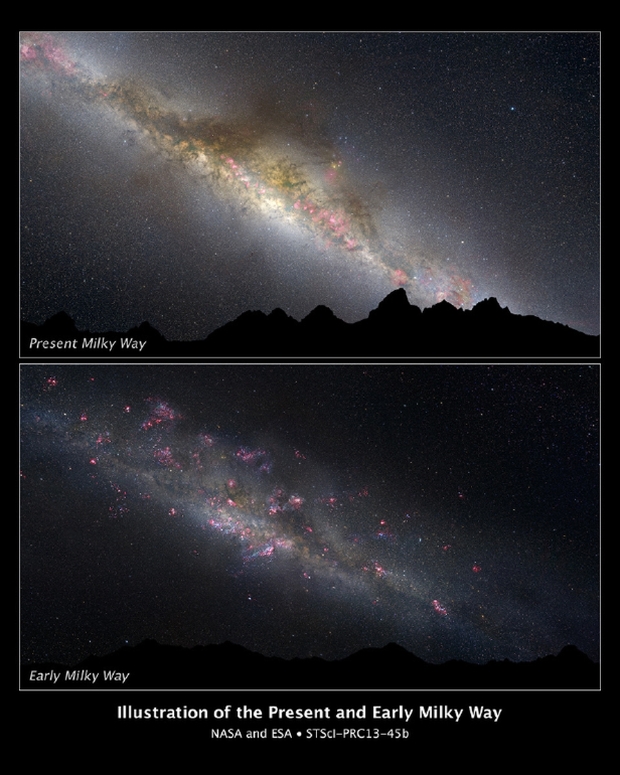
Image: The galaxy evolves. How many stars of the 400 billion now thought to exist here emerged at least a billion years before the Sun coalesced?
As always, though, we have to scout our assumptions. Just because it took what we now believe to be 4.6 billion years for Earth to produce intelligent life, why should that be the case everywhere else? An interesting new paper takes on that question by suggesting that no matter the size of their headstart, planets much older than our own may still be in the early stages of microbial life, without yet reaching the point of producing even primitive larger species.
The work of Chris Doughty (Northern Arizona University) and colleagues, the paper argues that we should be looking at what the team calls ‘plant energy,’ and stop focusing on time as an indicator of likely development. The hypothesis: “The biological evolution rate is a linear function of cumulative carbon fixed on a planet.” Note the word ‘fixed.’ What this describes is the process of taking carbon dioxide, an inorganic gas, and turning it into organic molecules like sugars. Photosynthesis does most of this work on Earth. It uses the energy derived from sunlight as the driver, with the carbon taken out of the atmosphere and oceans and put to use in biological systems.
Proposing a linear link between the amount of carbon fixed in this way and the rate of evolutionary development is a striking move. It’s even more so when considered as a tool for exoplanet research. The paper looks at the amount of carbon Earth has fixed over its lifetime and compares that to what other planets are likely to have fixed during their own lifetimes. 29 exoplanets are studied here, with only two of them surpassing Earth’s cumulative Net Primary Production (NPP), and therefore capable of developing multicellular and perhaps intelligent life. NPP refers to the carbon fixed by photosynthesis that ends up as new biomass.
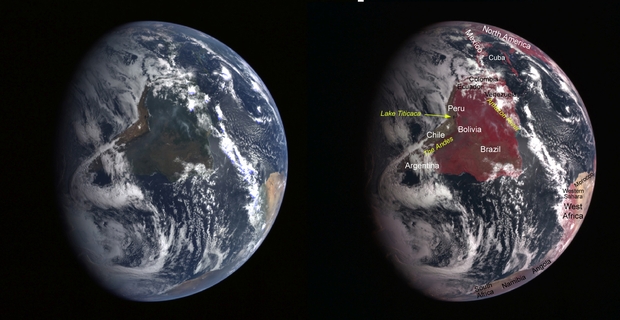
Image: How we see plant photosynthetic pigments. The MESSENGER image of Earth on the left is very close to what can be seen by the human eye. For the image on the right, a red component was substituted that shows near infra-red colors. The vegetation in the Amazon basin produces the purplish-red color in the center of the image. The new paper proposes that cumulative fixed carbon is itself a marker that can be tied not only to life but to the pace of evolutionary change. (Image credit: NASA/Johns Hopkins University Applied Physics Laboratory/Carnegie Institution of Washington, via JPL Photojournal).
The planets on Doughty’s list are chosen from the Habitable Worlds Catalog, which organizes NASA data based on factors such as radius, irradiation, temperature and age. The authors use stellar radiation, temperature and precipitation maps from several recent studies to calculate how Earth fixed carbon in different stages of biological evolution, and ask how long the examined planets would take to achieve the same amount of carbon.
From the paper:
Assuming Darwinian evolution, a baseline astrobiological assumption… each generation of life has a small potential for genetic change following either sexual or asexual reproduction. These genetic changes will either be successful or not depending on the environment, species competition or predation around the organism. We therefore hypothesize that Earth’s cumulative carbon fixed at certain periods has led to major evolutionary transitions such as the emergence of photosynthetic organisms, eukaryote and multicellular animals that fundamentally altered the Earth’s carbon cycle, accelerating it at certain points.
So we can think of the accumulated plant energy of an entire planet and acknowledge that planets with more plant growth as mediated by photosynthesis will tend to be warmer, wetter places than average. This gets interesting when we think about red dwarf planets, especially since these have enormous lifetimes and many are several billion years older than Earth. The authors make the case that these time factors provide no necessary advantage.
What counts is that life on a planet like TRAPPIST-1e, one of those studied here, would have lower rates of total photosynthesis because the surface receives correspondingly less light. Moreover, tidal lock on M-dwarf habitable planets would mean losing half their surface for photosynthesis. In this study, TRAPPIST-1e is found to have the capability of fixing no more than 21 percent of Earth’s carbon. An older world, but perhaps one with nothing more than microbial life.
We have interesting simulations of places like TRAPPIST-1e, climate maps that allow us to estimate how long it would take other planets to achieve the same amount of carbon fixed as we find on Earth. Of the 29 worlds considered potentially habitable by the authors, 27 are in fact orbiting red dwarf stars, and presumably tidally locked. Net Primary Production is calculated for each. The results are heavily weighted toward life at no more than microbial level:
If the biological evolutionary state is a function of cumulative carbon fixed and life began on each of the 29 exoplanets like it had on Earth, life on most of those 29 exoplanets would most likely be evolutionarily behind Earth (with two exceptions discussed below). The majority of our simulations led to most planets at the predicted microbial life stage with the exception of simulations using climates with 1 bar CO2. These very warm, wet planets accelerated NPP production which led about a third of the planets potentially ahead of Earth.
That sounds rather promising, but read on:
However, recent JWST observations showed no evidence of a thick carbon dioxide atmosphere on TRAPPIST-1c… or TRAPPIST-1e… therefore 1 bar CO2 may be unlikely on potentially habitable exoplanets. This raises the question of whether life can exist on an exoplanet with 1 bar CO2 in the atmosphere. CO2 concentrations in the early Earth may have been as high as 10 bar and up to ∼4,000 ppm CO2 in the atmosphere in the Cambrian (Royer, Reference Royer 2006), but 1 bar CO2 might not be conducive to land-based life.
The uncertainties here abound, as the authors are quick to acknowledge. We do not, in fact, know whether any of these planets actually have atmospheres in the first place. Nor, obviously, do we have any idea of their composition if they do exist. We have no knowledge about the presence of carbon at the surface, and also have to factor in the possibility of biological processes modifying the composition of any atmosphere present, just as Earth’s atmosphere was gradually transformed as the effects of photosynthesis began to be felt.
For that matter, can we assume that the life we are looking for uses carbon along the lines of life on Earth? If it does, this study predicts that most stars in our stellar neighborhood, despite sometimes being much older than Earth, are behind our planet when it comes to biological evolution. Two planets – GJ 1061c and K2-3d – do stand out as being of unusual observational interest for present and future space telescopes. Both are both larger and older than Earth.
This is useful information, given that our first thorough analyses of planets of Earth mass are going to occur with planets orbiting low mass stars. When we reach the point of instruments like Habitable Worlds Observatory that can image planets around G-class stars, the discouraging catalog analyzed in this paper may be replaced with a more positive one. If Doughty and team are right, however, we have an answer to the Fermi paradox and the time problem. Intelligent life has far fewer places on which to develop than we thought.
The paper is Doughty et al, Calculating potential cumulative carbon fixed and evolutionary stage for Earthlike planets in our solar neighborhood, International Journal of Astrobiology (2026). Published online by Cambridge University Press 22 September 2026. Full text.
0 Comments