
A research team at the University of Warwick (UK) has turned up what may be a planet orbiting a white dwarf. That’s an interesting find given the lifetime of white dwarfs after the parent star has lost its outer envelope. Any life on such a world would have several billion years to work with (see White Dwarfs and Habitable Planets for more), although this planet is far too young for that. But this find has other implications. If confirmed, it would be the first planet thought to have formed through accretion of materials left over from the death of the red giant. It would be evidence of a second generation, a planet-hosting period that begins after the red giant phase is over.
The star is HS 0209+0832, a young and hot white dwarf maybe five million years beyond the red giant phase. The original discovery came in 1999 by way of the Hubble Space Telescope, although the data had remained little studied in the archives since then. It took examination by doctoral candidate Jamie Williams at Warwick to explain some of the unusual chemical signatures lurking in the data. Over 100 chemical features from the initial Hubble observations needed clarification, and Williams discovered that a primary player was niobium.
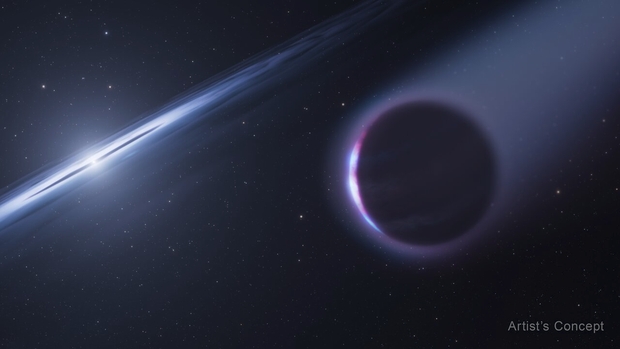
Image: This artist’s concept depicts a possible explanation for the unusual chemical abundances the NASA/ESA Hubble Space Telescope detected in the HS 0209+0832 system: a second-generation planet orbiting the white dwarf star. The white dwarf is the “dead” core of a star that burned through all of its nuclear fuel and lost its outer envelope of gas and dust to space. The second-generation planet formed from that cast-off gas and dust, which is why its chemical content is very different from a planet that formed as its host star was forming. Credit: NASA, ESA, L. Hustak (STScI).
This is interesting not only because of the idea of planet formation in a kind of ‘rebirth’ of a planetary system, but also because it opens up new lines of research. Here’s Williams, who is now lead author of a paper on this work:
“Rather than the white dwarf stage being a kind of epilogue to the story of a star and its planets, this research points to the systems we are familiar with only being the first chapter of a potentially much longer tale, with some new characters showing up. That’s a really exciting prospect to pursue. What Hubble is showing us in this white dwarf system is something we haven’t seen before: a high abundance of the element niobium, the signature of which I was unfamiliar with when I first found it in the archival data.”
To clarify what was going on in this unusual system required that Williams and team study not just the Hubble data but also that of further observations from the Far Ultraviolet Spectroscopic Explorer mission (FUSE), launched in 1999, the latter confirming the presence of niobium in the spectrum. Interestingly, the team looked at 33 other white dwarfs with signs of metal pollution in their atmospheres and found none with niobium. Further observations with TESS (Transiting Exoplanet Survey Satellite) showed periodic brightness variations consistent with a planet orbiting at approximately 6 million kilometers.
The niobium signature is critical because it is an element that is not formed in a stellar core through fusion. “Instead,” says co-author Nicholas Stone (University of Wisconsin – Madison) “these heavy elements can only be synthesised in the exotic conditions that briefly emerge inside dying stars. The presence of niobium is a signpost of these ‘death’ throes, and the expulsion of the dying star’s innards into space.”
The supposition is that material ejected from the dying star, enriched by exotic chemistry, coalesced into what appears to be a gas giant. The team argues that it is likely the size of Jupiter, and probably losing atmosphere given that the white dwarf would be stripping its outer material in such a tight orbit. Says Williams: “If the second-generation planet is there, I think it is likely to survive. Eventually the white dwarf will cool and then maintain a consistent temperature, with the planet in its stable habitable zone for millions of years.”
But forming this kind of disk is itself tricky. If planets like this are as rare as they seem, that may be because forming them requires another companion that helps to shepherd the ejected material from the dying star into orbit, rather than simply shedding it into interstellar space. For that, let’s look at the paper:
Assuming spherically symmetric mass loss, a second-generation proto-planetary disc is unlikely to form around a single AGB star, but there are several mechanisms that can lead to a disc if a binary companion was present. Evidence for the formation of such a disc has been found at the post-common envelope binary NN Ser as well as several post-AGB binaries. In particular, a close-in low-mass companion to the progenitor of HS 0209+0832 would have entered a common envelope event during the AGB phase, resulting in the ejection of the envelope and the formation of a circumstellar disc rich in s-process elements. A second-generation giant planet could have formed within that disc via direct gravitational collapse close to the white dwarf. Alternatively, a first-generation sub-Neptune or super-Earth that was scattered towards the second-generation proto-planetary disc could have accreted a second-generation atmosphere around a first-generation core.
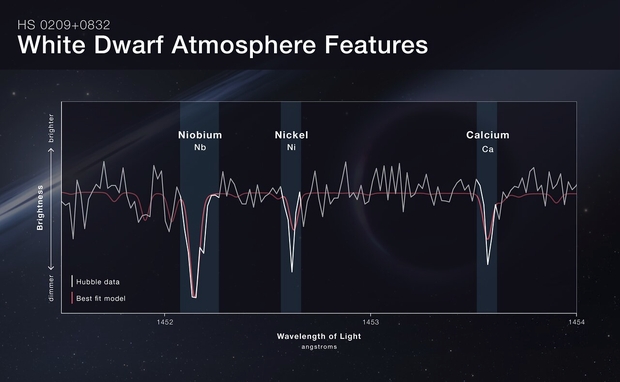
Image: This NASA/ESA Hubble Space Telescope spectrum shows the unusual abundances of certain elements it found in the HS 0209+0832 system. Dips indicate where niobium, nickel, and calcium are absorbing light, so less light in that part of the spectrum reached Hubble. The reason the starlight is showing elements that astronomers attribute to a planet has to do with interactions between the white dwarf star and planet. The white dwarf is still hot and is blasting the planet with radiation, causing it to lose atmosphere to space. That atmospheric material is flowing back toward the white dwarf, forming a disk and then falling back onto its surface. Credit: NASA, ESA, L. Hustak (STScI).
So while we can speculate about the fate of the inner planets in our Solar System when our Sun goes through its red giant phase, we may have to add in a scenario where a new inner system forms around a hot white dwarf with a long lifetime of its own. That’s assuming a mechanism that supports planet formation there. A still viable Jupiter using its formidable mass to shape a growing circumstellar cloud/disk? The example of HS 0209+0832 makes this at least plausible, although again, we have no good idea of how often such processes produce new planets.
White dwarfs will continue to energize research. From an exoplanet standpoint, imagine an Earth-size planet in transit across a white dwarf. That would be a transit signature for the ages. From the astrobiological perspective, consider that a white dwarf gradually loses heat because it has no fuel. This is a process, however, that can take several billion years before the star’s surface cools to the Sun’s current temperatures. Even that long life-time is eclipsed by the star’s eventual death as a ‘black dwarf,’ an inert object of a sort never observed because to reach that state would take longer than the age of the universe.
The paper is Williams et al., “Discovery of a second-generation planet candidate accreting onto a white dwarf,” Nature Astronomy 5 October 2026 (full text).


0 Comments