
Creating a ‘runway’ of fusion materials to accelerate a spacecraft as it leaves the Solar System is an idea with roots that go back into the 1970s. Greg Matloff and Al Jackson both contributed to the concept in that era, and Jordin Kare, a physicist, aerospace engineer and consultant on sail concepts, told me that he tapped both sources in developing his ‘Bussard Buzz-Bomb,’ which he presented at a JPL workshop in the late 1980s. The latter would involve placing deuterium and tritium pellets in such a way that a craft already moving at several hundred kilometers per second would encounter them. The kinetics at play here would produce fusion explosions at a rate of 30 per second.
I’ve discussed Kare’s runway ideas several times in these pages, the most recent being in Fusion Pellets and the ‘Bussard Buzz Bomb. Reading that entry again reminds me how wide a net we cast when we study interstellar concepts. There are some things we can do right now in laboratories, such as studying the kind of metamaterials from which we can construct sails that could fit into a beamed infrastructure, but in many cases we are of necessity creating purely theoretical work. The point is that this kind of brainstorming, tightened with solid physics, is how the entire enterprise grows. Ideas we cannot build today will only appear in the future with the benefit of this structural underpinning.
I’ll also grant that it can be frustrating to work in these areas. I remember watching a rerun of a Flash Gordon serial on TV when I was a kid, and thinking how much I wished I had been born in the future, where I could participate in space travel. But coming up with the idea that may one day get a payload to Proxima Centauri demands inspiration and the patience to pursue it even if its realization in hardware is decades, or more, away. Al Jackson was kind enough to send a copy of the paper he wrote with Daniel Whitmire that included a fusion runway. It was published in 1977 and we’re still a long way from being able to make it happen, but my friend Al is still pushing starship ideas. Exploring interstellar propulsion demands above all persistence.
In 1977, though, a fusion runway was only a tiny part of the speculation in a paper that focused on laser powered ramjet ideas. But the notion would stick around. To be specific, here is what I believe to be the first appearance of the runway as per Jackson and Whitmire, and I know Jordin Kare would have seen this because it ran in JBIS, an anchor for early interstellar work:
Another possibility would be to artificially make a fusion ramjet runway. Micron-size frozen deuterium pellets could be accelerated electrostatically or electromagnetically beginning several years prior to take-off at which time a fusion ramjet with a relatively modest scoop cross section (perhaps a physical structure) would begin acceleration.
The line of development goes through Jackson and Whitmire and then through interstellar polymath Greg Matloff, whose books and papers were such an influence on me as I learned about physics and the art of the possible. In a JBIS paper from 1979, Matloff considered the kinematics involved in a runway laid down by a tanker craft long before the ramjet spacecraft he contemplated was launched to use it. Matloff’s runway was made up of micropellets of helium-3 and deuterium, fusion fodder that would be ignited by lasers or electron beams aboard the ship.
Let’s put all this in the context of Robert Bussard’s 1960 paper on an interstellar ramjet, which saw the craft fueled by the interstellar medium itself in the form of hydrogen collected by the proposed magnetic scoop of the ramjet. The difficulties in the concept were immense, only beginning with the proton-proton reaction it would have used. Equally problematic, as this and subsequent work would show, is the problem of drag, which as Robert Zubrin later argued, made the basic concept better adapted to an interstellar braking device as a spacecraft entered a target system and slowed down from cruise velocity. Both John Ford Fishback and A. R. Martin had flagged this problem even earlier.
All of this makes the nature of the ramscoop a key factor in any ramjet concept. Moreover, we still need a way to bring a ramjet up to the speed necessary to ignite its main engine in the first place, given how tenuous the local interstellar medium is. Bussard’s baseline was a medium (ISM) density of roughly 1,000 protons per cubic centimeter, which is essentially a dense hydrogen cloud. Even in such a comparatively dense environment, Bussard’s calculations still demanded a ramscoop diameter of 120 kilometers (for a 1000 ton vehicle).
But within the so-called Local Bubble where we reside, the density of the medium is on the order of, at best, 0.1 to 0.3 atoms/cm³, making the region far more impoverished in gases than Bussard’s best case. Scale this for the actual interstellar medium around us and the funnel’s diameter swells to well over 3000 kilometers. To make the ramjet go, we need a dense cloud. The best candidate nearby seems to be the Rho Ophiuchius molecular cloud complex, about 450 light years away. But to use its densities you have to first get to it, which is where the fusion runway conceivably fits in.
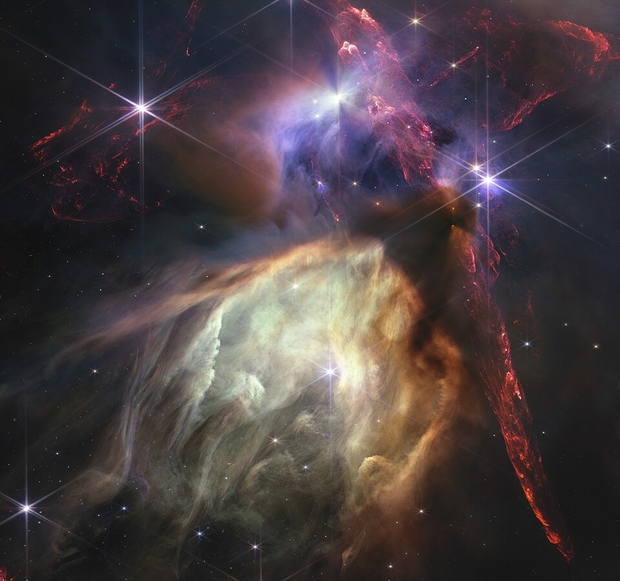
Image: The first anniversary image from the NASA/ESA/CSA James Webb Space Telescope displays star birth like it’s never been seen before, full of detailed, impressionistic texture. The subject is the Rho Ophiuchi cloud complex, the closest star-forming region to Earth. It is a relatively small, quiet stellar nursery, but you’d never know it from Webb’s chaotic close-up. Jets bursting from young stars crisscross the image, impacting the surrounding interstellar gas and lighting up molecular hydrogen, shown in red. Some stars display the telltale shadow of a circumstellar disc, the makings of future planetary systems. Credit: NASA, ESA, CSA, STScI, K. Pontoppidan (STScI), A. Pagan (STScI).
In the 1979 paper, Matloff credits Jackson and Whitmire for the runway idea and ponders it as a solution to this problem. His pellets ignited along the way could get a spacecraft up to speed, though likely insufficient to reach the Rho Ophiuchi or any other cloud complex in anything less than centuries. The paper calculates the reactions created as an accelerating spacecraft encounters its fuel. The results make for a striking scenario. From the paper, looking at one of two models (A and B) Matloff considers:
Since, for Ramjet B, the tanker cruise velocity will be 0.002c, tankers must be launched over a 50 year period to produce a runway 0.1 light years long. A starship accelerating along this runway to 0.2c would have an average acceleration of 0.2 g and would require a one year acceleration time. The spacecraft would consume 45.5 times its mass in fusion fuel during the accelerating period.
Imagine, then, 100 tankers extended through a 0.1 light year runway, their average separation being 1010 kilometers. Perhaps, the author muses, the pellets could be electrically charged, thus aiding the fuel collection by the ramjet’s scoop. Obviously, the demands on placement of the individual tankers are enormous, but the physics works. If we can use a runway to get a ramjet up to speed, we can light its primary engine for interstellar travel.
Or barring that, we might still experiment with the idea, at a more modest scale, for missions within the Solar System. Matloff speculates, for example, on using scoop technologies to collect fusion fuel from the solar wind over decades. Such an approach could provide fuel to power a ram-augmented interstellar rocket (RAIR), a concept that’s likewise due for another look in these pages.
Note this, from the Matloff paper:
Even the pure ramjet of the 3He-D variety is worthy of further consideration in any comparison of potential interstellar propulsion schemes… If a small interstellar colonizing mission requires 2 x 10⁷ kgm of mass, excluding fuel, it should be possible to distribute this mass among a flotilla of half a dozen or so small (~ 4 x 10⁶ kgm) ramjets. Even with a 10-3 g acceleration limit, such craft may be capable of reaching one of the very nearest stars in about one human lifetime, provided that a suitable reactor can be developed.
Even a spacecraft considerably slower than Bussard imagined, if boosted along this kind of runway, could conceivably propel one way interstellar trips to nearby stars. So the idea continues to be intriguing, which brings me back to Al Jackson’s latest paper, where the original concept is adapted to fission or fusion devices. There are echoes here of Project Orion as well as a current science fiction tale that has achieved high visibility. More on that next time.
Robert Bussard’s original ramjet paper is Bussard, R. W., “Galactic Matter and Interstellar Flight,” Astronautica Acta 6 (1960), pp. 179–195. Al Jackson’s original paper mentioning runway concepts is Jackson & Whitmire, “Laser Powered Interstellar Ramjet,” Journal of the British Interplanetary Society 30 (1977, pp. 223-226. Greg Matloff’s paper on fusion runways is Matloff, G., “The Interstellar Ramjet Acceleration Runway,” JBIS 32 (1979), 219-220. Al Jackson’s latest paper on runways is Jackson, “Bomb Shot: A Nuclear Runway,” JBIS 79, 11 (November 2026), 411.


0 Comments