
The 2005 Winter Conference on Astrophysics is now in session in Aspen, with papers running through tomorrow. The topics here make up a wish list for those interested in learning more about the next steps in extrasolar planet detection and analysis. Tomorrow’s last session, for example, is on new technologies for detection, includng the Terrestrial Planet Finder mission. Earlier sessions have included everything from theories of giant planet formation to planetesimals and how they form in protoplanetary disks.
But the first story out of the conference to hit the media was the detection of possible planets around a small brown dwarf called OTS 44, which is only 15 times the mass of Jupiter — before now, the smallest brown dwarf implicated in debris disk formation was almost 30 times the mass of Jupiter. You can see how this hypothetical planetary system scales next to our own in the image below. OTS 44 is approximately 500 light years away in the Chameleon constellation.
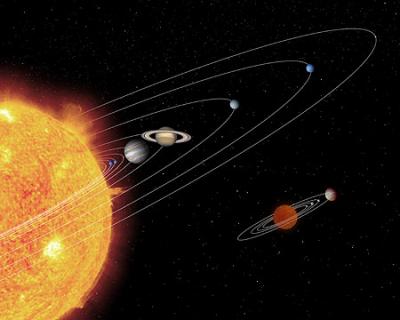
Image: This artist’s conception shows the relative size of a hypothetical brown dwarf-planetary system (below) compared to our own solar system.
A brown dwarf is a cool or “failed” star, which lacks the mass to ignite and shine like our Sun. NASA’s Spitzer Space Telescope set its infrared eyes on an extraordinarily low-mass brown dwarf called OTS 44 and found a swirling disk of planet-building dust. At only 15 times the mass of Jupiter, OTS 44 is the smallest known brown dwarf to host a planet-forming, or protoplanetary, disk.
Astronomers believe that this unusual system will eventually spawn planets. If so, they speculate that OTS 44’s disk has enough mass to make one small gas giant and a few Earth-sized rocky planets.
Examples of these possible planets are depicted at the bottom of this picture, circling a low-mass brown dwarf. Above, the bodies of our own solar system have been drawn to the same scale. In each system, the terrestrial planets have been enlarged and the distances between the planets and their parent bodies have been scaled down for easier viewing.” Credit: NASA/JPL-Caltech/T. Pyle (SSC).
This work, which was carried out using NASA’s Spitzer Space Telescope (see the Spitzer press release here) raises some interesting speculations. “There may be a host of miniature solar systems out there, in which planets orbit brown dwarfs,” said Dr. Kevin Luhman, lead author of the new study from the Harvard-Smithsonian Center for Astrophysics, Cambridge, Mass. “This leads to all sorts of new questions, like ‘Could life exist on such planets?’ or ‘What do you call a planet circling a planet-sized body? A moon or a planet?'”
Another interesting setting for science fiction:
“If life did exist in this system, it would have to constantly adjust to the dwindling temperatures of a brown dwarf,” said Luhman. “For liquid water to be present, the planet would have to be much closer to the brown dwarf than Earth is to our Sun.”
“It’s exciting to speculate about the possibilities for life in such as system, of course at this point we are only beginning to understand the unusual circumstances under which planets arise,” he added.
The paper “Spitzer Identification of the Least Massive Known Brown Dwarf with a Circumstellar Disk,” by Luhman, Alession, Calvet et.al., will appear in the February 10 issue of The Astrophysical Journal Letters and is available from the Spitzer site (PDF warning).
Much more about the Aspen conference after I get over the flu — there is material galore in these proceedings.

0 Comments