
A story in a recent issue of New Scientist covers the possibility of planets around brown dwarfs, focusing on the work of Kevin Luhman of the Harvard-Smithsonian Center for Astrophysics. Centauri Dreams looked at this study in a previous posting, but writer Hazel Muir adds a further comment on habitability around such worlds based on Luhman’s work:
It is conceivable that such planets, if they form, could be habitable. The surface temperature of the mini brown dwarf is 2300 kelvin, so a planet 1.5 to 7 million kilometres away could host liquid water. Planets very close to a brown dwarf would be scorched at first, but would become hospitable as the star cooled. Brown dwarfs take a long time to cool, so the planet could remain habitable long enough for life to evolve.
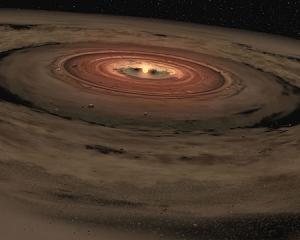 Another thought, from Andrew Collier Cameron at the University of St. Andrews in the UK, who is quoted in the article: brown dwarfs might be useful hunting grounds for exoplanets, given the faintness of the brown dwarf primary. Planets orbiting bright stars are usually drowned in the star’s glare, but careful use of the infrared, as with Luhman’s work with the Spitzer Space Telescope, could make the search for brown dwarf companions quite interesting. At the long wavelengths Spitzer specializes in, the disc around a brown dwarf appears brighter than the parent star.
Image: This artist’s concept shows a brown dwarf surrounded by a swirling disk of planet-building dust. NASA’s Spitzer Space Telescope spotted such a disk around a surprisingly low-mass brown dwarf, or “failed star. The brown dwarf, called OTS 44, is only 15 times the size of Jupiter, making it the smallest brown dwarf known to host a planet-forming, or protoplanetary disk. Astronomers believe that this unusual system will eventually spawn planets. If so, they speculate that OTS 44’s disk has enough mass to make one small gas giant and a few Earth-sized rocky planets. Credit: NASA/JPL-Caltech/T. Pyle (SSC)
The article in New Scientist is “Mini Star Could Offer Save Haven to Life,” which ran in the February 12 issue (also available online but only to subscribers).
0 Comments