
Understanding how galaxies form is no easy matter, particularly when you factor in dark matter. Without a firm knowledge of what dark matter actually is, we’re limited to discussing its perceived effects, something that researchers at Hebrew University of Jerusalem have coupled with computer simulations that change how we view the early universe.
The large galaxies some three billion years after the Big Bang apparently didn’t form from the merger of smaller disks of material, says this team. That earlier theory would have seen slow star formation as the various disks eventually came together. But the latest observations show that early galaxies created stars at a rapid rate. The new theory may explain why. It sees galaxies forming as the result of cold hydrogen flowing in narrow streams along the filaments of the so-called ‘cosmic web’ that defines the large scale structure of matter in the universe.
These hydrogen streams would feed into the halos of dark matter that are believed to enshroud the forming galaxies, helping the emergence of a rotating disk at the center. The computer models show that this continuing infall of cold gas produces a scenario that promotes star formation.
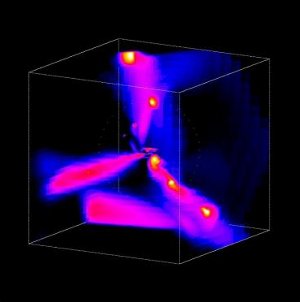
In fact, the Hebrew University team has worked out a physical theory that traces the formation of gas clumps in the early disks and shows how such cosmic streams could drive them. What’s especially interesting is that the theory offers a way to explain the formation of elliptical galaxies in the early universe. These are the galaxies, far more rounded in shape than spirals like the Milky Way, that house predominately old, red stars.
Image: Computer simulation of galaxy formation shows matter flowing into the center of a galaxy through three cold gas streams. Such pictures provide the basis for the new theory of galaxy formation via these streams. Credit: The Hebrew University of Jerusalem.
It’s fascinating stuff, incorporating as it does the latest thinking on dark matter. But it’s also a reminder of how much we still have to learn about dark matter itself as we put these simulations to further tests. What breakthroughs may lie ahead as we continue to study what this mysterious ‘stuff’ is will keep us pursuing dark matter stories in these pages.
The paper is Dekel, “Cold streams in early massive hot haloes as the main mode of galaxy formation,” Nature 457 (January 22, 2008), pp. 451-454 (abstract). A Hebrew University news release is here.

Hi Folks;
Mapping out the entire topography of these gas filaments and galaxy distributions could be critical for some future improved interstellar, or should I say, intergalactic ramjet manned space craft or other space craft such as electrodynamic-hydrodynamic-plasma drive vehicles.
Perhaps where there is a bit of hydrogen and helium, there is more. I do not really know what the state of the present thinking is on intergalactic hydrogen/helium distribution is wiith respect to the universe’s filamentary baryonic matter distribution, but I would not be surprised if vaste quantities of intergalactic fusion fuel are available in great enough densities to power future fusion powered intergalactic starships.
Perhaps Cold Dark Matter will lead to another epoch of galaxy formation once the CDM has a chance to have another round at collecting fusionable gases. One relevent thing in particular would be the case that cold dark matter that currently exists would decay into species of CDM particles which have differing hydrodynamic, “plasma”hydrodynamic, or other fluid dynamic properties that have not yet been modeled by current conputational fluid dynamics, finite element analysis, or other forms large scale numerical simulations of the evolution of our universe for evolutioary epochs over the next 10 billion to 100 billion years.
Thanks;
Jim
The NASA/ESA Hubble Space Telescope has uncovered a strong new line of evidence that galaxies are embedded in halos of dark matter.
More at:
http://www.esa.int/esaSC/SEMM2NITYRF_index_0.html
Is There a Dark Matter Signal in the Galactic Positron Annihilation Radiation?
Authors: R.E. Lingenfelter, J.C. Higdon, R.E. Rothschild
(Submitted on 6 Apr 2009 (v1), last revised 9 Apr 2009 (this version, v2))
Abstract: Assuming Galactic positrons do not go far before annhilating, a difference between the observed 511 keV annihilation flux distribution and that of positron production, expected from beta-plus decay in Galactic iron nucleosynthesis, was evoked as evidence of a new source and a signal of dark matter.
We show, however, that the dark mater sources can not account for the observed positronium fraction without extensive propagation. Yet with such propagation, standard nucleosynthetic sources can fully account for the spatial differences and the positronium fraction, leaving no signal for dark mater to explain.
Comments: 4 pages, no figures, 85 references
Subjects: High Energy Astrophysical Phenomena (astro-ph.HE)
Cite as: arXiv:0904.1025v2 [astro-ph.HE]
Submission history
From: Richard E. Rothschild [view email]
[v1] Mon, 6 Apr 2009 22:24:54 GMT (9kb)
[v2] Thu, 9 Apr 2009 21:23:12 GMT (9kb)
http://arxiv.org/abs/0904.1025