
Getting an image of a planet around another star has been an elusive goal for astronomers, and most candidates have proven to be background stars, or sometimes faint stellar members of what turned out to be binary systems. Now a new candidate has emerged. An international team of astronmers, using observations from the the ESO Paranal Observatory in northern Chile, has picked up what may be a gas giant planet orbiting the brown dwarf 2M1207 at approximately twice the distance between the Sun and Neptune. The object is located in the far southern sky in the direction of the constellation Hydra, and is approximately 230 light years away.
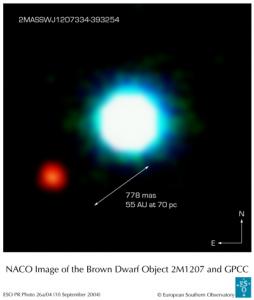 The photograph at left is based on three near-infrared exposures (in the H, K and L’ wavebands) with the NACO adaptive-optics facility at the 8.2-m VLT Yepun telescope at the ESO Paranal Observatory.
More observations are needed, but what’s interesting about this ‘Giant Planet Candidate Companion,’ as it is being called, is that its spectrum shows water-band absorption in its atmosphere. In other words, the spectral signature is closer to that of a gas giant than a brown dwarf. The possibility that this could be a foreground or background brown dwarf cannot be ruled out, but if we are witnessing a planetary object in orbit around 2M1207, studying their respective motions for an extended period should clinch the deal.
Says Anne-Marie Lagrange, a member of the team from France’s Grenoble Observatory: “Our discovery represents a first step towards opening a whole new field in astrophysics: the imaging and spectroscopic study of planetary systems. Such studies will enable astronomers to characterize the physical structure and chemical composition of giant and, eventually, terrestrial-like planets.”
See G. Chauvin, et. al., “A Giant Planet Candidate near a Young Brown Dwarf,” soon to appear in Astronomy and Astrophysics. The preprint of this paper is available here. Also see “Is This Speck of Light an Exoplanet?” (ESO’s news release with accompanying data).

0 Comments