
Getting a spacecraft to Mars and back in 90 days is one result of developing magnetized-beam plasma propulsion. Mag-beam is the idea of Robert Winglee, whose earlier work on mini-magnetospheric plasma propulsion (M2P2) used the solar wind to push against a plasma bubble created around a spacecraft. Instead of the solar wind, mag-beam uses a plasma beam sent from a space-based station. Its magnetized ions would push against a magnetic sail at speeds that could vary with the size of the beam.
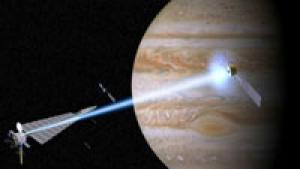 “Winglee estimates that a control nozzle 32 meters wide would generate a plasma beam capable of propelling a spacecraft at 11.7 kilometers per second. That translates to more than 26,000 miles an hour or more than 625,000 miles a day,” according to this press release from the University of Washington, where Winglee is a space sciences professor.
Image: In this artist’s conception, a plasma station (lower left) applies a magnetized beam of ionized plasma to a spacecraft bound for Jupiter. Credit: John Carscadden, University of Washington.
But mag-beam has richer implications than a single Mars mission. By leaving the propellant behind, spacecraft exploring deep space would do away with huge, bulky engines and the fuel to drive them. The fuel problem is what attracted Robert Forward to the solar sail concept, which he then modified for interstellar use through his work on ‘lightsails’ — enormous sails driven by space-based lasers. Mag-beam has the potential of becoming the first demonstration of practical beamed propulsion, although we may soon have an earlier test, bouncing microwaves off the Cosmos 1 solar sail developed by The Planetary Society, which is due to be launched some time in 2005.
Winglee forsees plasma stations being placed throughout the Solar System, some for initial propulsion and some to slow returning spacecraft. Stations close to the Sun would create ionized plasma using solar energy; those in the outer Solar System could use nuclear power. The mag-beam project will be discussed at the sixth annual meeting of NASA’s Institute for Advanced Concepts, to be held in Seattle next week. Mag-beam is one of twelve proposals that received funding from NIAC this month.
From the press release:
Winglee acknowledges that it would take an initial investment of billions of dollars to place stations around the solar system. But once they are in place, their power sources should allow them to generate plasma indefinitely. The system ultimately would reduce spacecraft costs, since individual craft would no longer have to carry their own propulsion systems. They would get up to speed quickly with a strong push from a plasma station, then coast at high speed until they reach their destination, where they would be slowed by another plasma station.
“This would facilitate a permanent human presence in space,” Winglee said. “That’s what we are trying to get to.”
More details on Winglee’s work can be found here.
0 Comments