
Fusion is often in the picture when interstellar propulsion systems are discussed, but so far we don’t know how to sustain the process past the breakeven point. Ongoing research is intensive, however, and the latest in inertial confinement fusion (ICF) concepts will be examined in mid-November in Savannah, GA. That’s when the American Physical Society’s Division of Plasma Physics holds its 46th annual meeting.
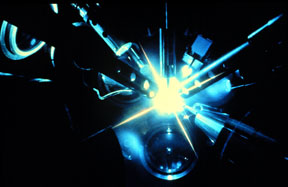 Inertial confinement fusion works by heating and compressing tiny fuel capsules with laser beams. Significant advances have been reported from the University of Rochester’s Laboratory for Laser Energetics, whose researchers will present the results of their tests of OMEGA, a 60-beam laser facility that is designed for the National Ignition Facility, a fusion laser facility scheduled to be completed later in the decade.
Image: Inertial confinement fusion at the Trident laser facility at Los Alamos National Laboratory.
Here is a description of ICF from Los Alamos National Laboratory: “In an inertial confinement fusion reaction, energy is rapidly applied to the surface of the fusion capsule which causes the solid surface to vaporize or turn into a gas. Upon vaporization this material swiftly moves away from the remaining capsule material in a rocket-like manner. This projection of gas away from the surface creates shock waves that move through the capsule, compressing and heating the interior hydrogen isotopes. Using this technique it is possible to create conditions, similar to that in a star, which are necessary for fusion to occur. As the materials fuse they give off energy, that causes the other hydrogen nuclei to heat up and begin to expand. This expansion is limited by the tendency of the shock waves to continue compressing the material from the outside, otherwise known as inertia. The net result is an inertially confined fusion reaction.” Source: Los Alamos ICF page.
Centauri Dreams‘ take: as far back as the 1970s, the British Interplanetary Society was using a form of intertial confinement fusion to power up its hypothetical Project Daedalus starship, an unmanned probe to Barnard’s Star. Even earlier, in 1966, Dwain Spencer’s paper “Fusion Propulsion for Interstellar Missions” (Annals of the New York Academy of Science 140, December 1966: 407-18) became one of the first to discuss practical fusion concepts in relation to interstellar flight. Spencer described an engine that burned deuterium and helium-3 gases in a combustion chamber ringed with superconducting magnetic coils to keep the hot plasma from contacting the chamber’s walls, a design that could reach three-fifths of the speed of light.
Today ICF concepts are proliferating, with some, like University of Michigan professor Terry Kammash’s Magnetically Insulated Inertial Confinement Fusion, using small amounts of antimatter to light the reaction instead of lasers. Here’s an abstract of “MICF: A fusion propulsion system for interstellar missions,” a paper written by Kammash and Brice Cassenti on MICF. Whatever progress the University of Rochester team can report on other ICF ideas will be well worth noting, and you can bet Centauri Dreams will keep an eye on it.
The gathering, which will be held at the Savannah International Trade and Convention Center from the 15th to the 19th of November, will see 1425 papers covering advances in plasma-based research and technology.
For more on inertial confinement fusion, the General Atomics pages on ICF are here. And here is the Web page for the APS meeting.

It is not necessary to achieve the energy break even point to build and operate a thermonuclear rocket engine. The goal of rocketry is high specific impulse not electric power generation.