
The idea that rocks may travel between planets is now widely accepted. But can rocks or other planetary ejecta wander between solar systems? A new paper examines this hypothesis, concluding that rocky materials and even life-bearing meteorites may make their way from one planetary system to the next. But here’s the catch: this transfer is only likely between stars in young stellar groups and clusters, where the distances and relative velocities between stars are low. The authors — the University of Michigan’s Fred C. Adams and Princeton’s David N. Spergel — note that most stars occur in binary systems, making the chance of such transfer that much higher.
The operative term is ‘lithopanspermia,’ the notion that life travels between worlds aboard meteorites. It is a variation on the older panspermia theory, which argued that life arrived directly from space. The concept dates back as far as Anaxagoras (5th Century B.C.) and was championed by Lord Kelvin, who declared in 1871, “…we must regard it as probable in the highest degree that there are countless seed-bearing meteoric stones moving about through space. If at the present instance no life existed upon this earth, one such stone falling upon it might, by what we blindly call natural causes, lead to its becoming covered with vegetation.”
Panspermia came to the public’s attention through the work of Swedish chemist Svante Arrhenius, whose Worlds in the Making: The Evolution of the Universe (New York: Harper & Row, 1908) talked of spores moving between planets by the pressure of starlight. It was given a powerful boost by the discovery of meteorites that are almost certainly Martian in origin.
Adams and Spergel calculate that although the odds of any given rock being captured by another solar system are low, the sheer number of ejected rocks is likely to be high enough that all solar systems share some materials with other systems in their birth cluster. From the paper:
This paper shows that young star clusters provide an efficient means of transferring rocky material from solar system to solar system. If any solar system in the birth aggregate supports life, then many other solar systems in the cluster can capture life bearing rocks. Only a fraction of these systems will feed biologically active rocks onto the surfaces of terrestrial planets, however, so the odds of successful lithopanspermia are low: In the limit of low speed ejecta, only a few systems per cluster are expected to be biologically seeded through this mechanism, although the efficiency is reasonably high… If the origin of life is relatively common and if life bearing rocks can be ejected at low speeds, then dynamical interactions in stellar birth clusters would provide an effective mechanism for spreading life.
 Centauri Dreams‘ take: Note that young stellar systems offer the best opportunity for capturing biologically active materials from another system, because the planets are still forming and collisions between planetary debris would be common. In this setting, rocky materials may well contribute to the formation of planets which would thus have the potential for life more or less built into them. Also note the authors’ view that a key figure in their study — the fraction of captured material that falls onto the surface of habitable planets — is in need of additional calculations. Much work remains to be done, but the current conclusion is intriguing: “…optimistic circumstances allow a cluster, once biologically seeded, to transfer life to the majority of its solar systems through the process of lithopanspermia.”
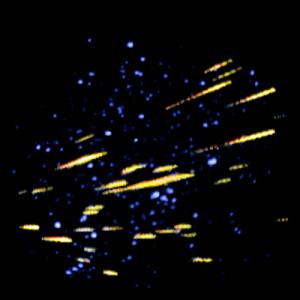
Image: The Alpha-Monocerotid meteor outburst in 1995. Is it possible that life falls onto habitable worlds from such events? Credit: S. Molau and P. Jenniskens, NASA Ames Research Center.
Fred Hoyle and Chandra Wickramasinghe have studied the properties of biological material falling onto planetary surfaces; see their 1999 paper “The viability with respect to temperature of microoganisms incident on the Earth’s atmosphere,” Astrophys. Space Sci. 268, 45-50. The duo have argued for decades that complex organic materials and even primitive organisms might have arrived on Earth by way of comets or meteorites. Giving further credence to the hypothesis is the survival of viable bacteria on the Surveyor 3 moon lander, retrieved by the Apollo 12 astronauts after two and a half years on the Moon.
“Lithopanspermia in Star Forming Clusters” is now available on the arXiv site and has been accepted by Astrobiology for future publication.



Detection of an intergalactic meteor particle with the 6-m telescope
Authors: V.L. Afanasiev (1), V.V. Kalenichenko (2), I.D. Karachentsev (1) ((1) Special Astrophysical Observatory Russian Academy of Sciences (2) Astronomical Observatory, Kyiv Taras Shevchenko University)
(Submitted on 10 Dec 2007)
Abstract: On July 28, 2006 the 6-m telescope of the Special Astrophysical Observatory of the Russian Academy of Sciences recorded the spectrum of a faint meteor. We confidently identify the lines of FeI and MgI, OI, NI and molecular-nitrogen N_2 bands. The entry velocity of the meteor body into the Earth’s atmosphere estimated from radial velocity is equal to 300 km/s. The body was several tens of a millimeter in size, like chondrules in carbon chondrites. The radiant of the meteor trajectory coincides with the sky position of the apex of the motion of the Solar system toward the centroid of the Local Group of galaxies. Observations of faint sporadic meteors with FAVOR TV CCD camera confirmed the radiant at a higher than 96% confidence level.
We conclude that this meteor particle is likely to be of extragalactic origin. The following important questions remain open: (1) How metal-rich dust particles came to be in the extragalactic space? (2) Why are the sizes of extragalactic particles larger by two orders of magnitude (and their masses greater by six orders of magnitude) than common interstellar dust grains in our Galaxy? (3) If extragalactic dust surrounds galaxies in the form of dust (or gas-and-dust) aureoles, can such formations now be observed using other observational techniques (IR observations aboard Spitzer satellite, etc.)? (4) If inhomogeneous extragalactic dust medium with the parameters mentioned above actually exists, does it show up in the form of irregularities on the cosmic microwave background (WMAP etc.)?
Comments: 9 pages, 6 EPS figures
Subjects: Astrophysics (astro-ph)
Journal reference: Astrophysical Bulletin, 2007, v. 62, p. 301-310
Cite as: arXiv:0712.1571v1 [astro-ph]
Submission history
From: Alexei Moiseev [view email]
[v1] Mon, 10 Dec 2007 19:11:42 GMT (401kb)
http://arxiv.org/abs/0712.1571