
The DARWIN Mission: Picking the Right Star

by | May 4, 2005 | Exoplanetary Science

The European Space Agency’s DARWIN mission is all about detecting Earth-like planets, as well as analyzing their atmospheres and determining their ability to sustain life. With the mission currently in its ‘definition’ phase, where parameters are determined and designs weighed, Lisa Kaltenegger (Harvard-Smithsonian Center for Astrophysics) has made her Ph.D work in astrophysics available to interested scientists. Written for Karl Franzens University in Graz, Kaltenegger’s study presents her work with the DARWIN team at the European Space Agency. Here you’ll find an evaluation of alternative designs and mission targets; the section on defining the features of a habitable world alone is worth the download of this enormous PDF file.

Scheduled for launch some time after 2014, DARWIN is a space-based interferometer designed to operate by pooling the data from free-flying craft working in tandem. At the heart of Kaltenegger’s work is a discussion of target star selection for DARWIN. As matters currently stand, some 826 stars (including multiple systems) are in the running, a list that will be narrowed with further modeling. Some salient points:
  • At least 100 to 150 stars will be needed for observation since the frequency of extrasolar terrestrial planets remains unknown.
  • G-type stars like our Sun make natural targets, but other stellar types (M-class red dwarfs, for example) should not be excluded. “It is essential that we have a certain number of targets stars to derive conclusions for detections or non-detections. Even though the frequency of extra-solar terrestrial planets can only be guessed, we believe that a sample has to consist of about 100 to 150 stars to be able to derive conclusions,” Kaltenegger writes.
  • Target stars will be limited to those within 25 parsecs.
  • Binaries will be investigated in cases where the light from a second star does not overwhelm the detectors and mask any planetary signal; this will vary depending on the different stellar types of the stars observed.
  • Because most stars near the Sun are variable stars, the question of how much variability is acceptable while still retaining conditions for Earth-like planets to form must be investigated further. “We should be ready for surprises on what reactions exist to stabilize habitable conditions on planets, including reactions we might not be aware of now…”
  • Young stars should be secondary targets because of the time needed for terrestrial worlds to form. But studying different stages in planetary evolution is part of DARWIN’s objective, and some young stars will remain in the target sample.
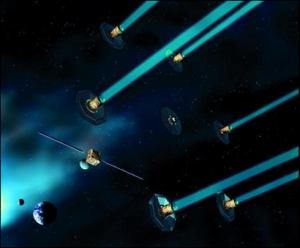
  • Artist\'s conception of Darwin missionMissions like DARWIN will add new depth to our understanding of exoplanetary systems. As Kaltenegger notes, the sensitivity of our current detection methods introduces an enormous bias in the direction of high mass companions close to the parent star; these are the most likely objects to be discovered by noting the apparent ‘wobble’ in a star’s motion as it is affected by such worlds.

    Image: Darwin’s six telescopes look at light from space and analyse the atmospheres of Earth-like planets. Copyright: ESA 2002. Illustration by Medialab.

    Can terrestrial planets form in such systems, or would those giant, close-in planets create instabilities fatal to their development? We won’t know the answers until DARWIN and Terrestrial Planet Finder provide us a big enough sample to draw some conclusions, and that makes the choice of target stars a critical matter.

    “Search for Extra-Terrestrial planets: The DARWIN mission – Target Stars and Array Architectures” is available here, or via Kaltenegger’s page at the Center for Astrophysics site. Also see ESA’s home page for Darwin.

    0 Comments

    Now Reading

    Charter

    In Centauri Dreams, Paul Gilster looks at peer-reviewed research on deep space exploration, with an eye toward interstellar possibilities. For many years this site coordinated its efforts with the Tau Zero Foundation. It now serves as an independent forum for deep space news and ideas. In the logo above, the leftmost star is Alpha Centauri, a triple system closer than any other star, and a primary target for early interstellar probes. To its right is Beta Centauri (not a part of the Alpha Centauri system), with Beta, Gamma, Delta and Epsilon Crucis, stars in the Southern Cross, visible at the far right (image courtesy of Marco Lorenzi).

    Recent Posts

    On Comments

    If you'd like to submit a comment for possible publication on Centauri Dreams, I will be glad to consider it. The primary criterion is that comments contribute meaningfully to the debate. Among other criteria for selection: Comments must be on topic, directly related to the post in question, must use appropriate language, and must not be abusive to others. Civility counts. In addition, a valid email address is required for a comment to be considered. Centauri Dreams is emphatically not a soapbox for political or religious views submitted by individuals or organizations. Human comments only, please -- cut and paste from AI will not be acceptable. A long form of the policy can be viewed on the Administrative page. The short form is this: If your comment is not on topic and respectful to others, I'm probably not going to run it.


    Advanced Propulsion Research

    Beginning and End

    Archives