The Kuiper Belt yields up its secrets grudgingly, but sometimes we get help from objects much closer to the Sun. Cassini’s flyby of Saturn’s moon Phoebe on June 11, 2004 has provided all the information scientists needed to declare the ancient object a relic from the outer Solar System, much like Pluto and other Kuiper Belt members. Two papers in Nature provide our best look yet at Phoebe.
Determining a planetary object’s origin isn’t easy, but Phoebe can be analyzed in terms of its density, which is calculated on the basis of the moon’s mass studied in relation to volume estimates from the Cassini images. The resulting figure is 1.6 grams per cubic centimeter, lighter than most rocks but heavier than pure ice, and suggesting an ice/rock composition similar to Pluto and Neptune’s moon Triton.
“Cassini is showing us that Phoebe is quite different from Saturn’s other icy satellites, not just in its orbit but in the relative proportions of rock and ice. It resembles Pluto in this regard much more than it does the other Saturnian satellites,” said Dr. Jonathan Lunine, Cassini interdisciplinary scientist from the University of Arizona, Tucson.
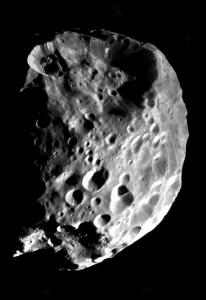 A second paper analyzes Phoebe’s surface composition. Imaging spectroscopy has revealed Phoebe to be “…one of the most compositionally diverse objects yet observed in our Solar System. It is likely that Phoebe’s surface contains primitive materials from the outer Solar System, indicating a surface of cometary origin,” write Roger N. Clark and team.
Image: Phoebe’s true nature is revealed in startling clarity in this mosaic of two images taken during Cassini’s flyby on June 11, 2004. The image shows evidence for the emerging view that Phoebe may be an ice-rich body coated with a thin layer of dark material. Small bright craters in the image are probably fairly young features. Credit: NASA/JPL/Space Science Institute.
More on Phoebe in the May 5 issue of Nature. The papers are Torrence Johnson and Jonathan Lunine, “Saturn’s moon Phoebe as a captured body from the outer Solar System,” Nature 435, 69-71 (5 May 2005 — abstract available here); see also Roger Clark, Robert H. Brown et al., “Compositional maps of Saturn’s moon Phoebe from imaging spectroscopy,” Nature 435, 66-69.