
A team of NASA and university-based investigators is studying the physics of magnetic nozzles, devices that could be used in plasma-based propulsion systems that would sharply reduce the length of journeys within the Solar System. The project began in April and is led by the University of Texas, with support from Marshall Space Flight Center in Huntsville (AL), along with the University of Alabama at Huntsville and NASA’s Johnson Space Center in Houston.
“The technology we’re pursuing could play an important role in NASA’s exploration of the Moon, Mars and the rest of the Solar System,” said Dr. Greg Chavers, a plasma physicist at Marshall and co-investigator for the new project. “Magnetic nozzles enable a new type of plasma-based propulsion system that could significantly reduce travel times to different planetary destinations, providing a new means of exploring space.”
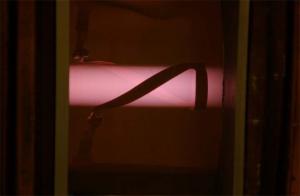 Plasma forms when a hot gas is ionized, causing the atoms to lose their electrons and take on a positive charge. That charge is the key — it allows a magnetic nozzle to accelerate the plasma to far higher velocities than those available through chemical propulsion systems. In rocket terms, the nozzle allows much higher specific impulse (ISP), which tells us a great deal about the engine’s efficiency.
Image: In April, NASA scientists began generating plasma energy in a 9-inch vacuum chamber in NASA’s Propulsion Research Laboratory at the Marshall Space Flight Center in Huntsville, Ala. Credit: MSFC.
Specific impulse measures how much thrust is produced per unit of fuel in each second of a rocket engine’s burn. Put another way, it is a measure of how many seconds one pound of propellant can produce one pound of thrust (which is why ISP is measured in ‘seconds’).
We need breakthroughs in specific impulse to achieve manned missions to the outer planets, and even greater breakthroughs to enable interstellar missions. The Space Shuttle’s main engines deliver an ISP of roughly 465 seconds. Missions to the Kuiper Belt, from 100 to 1000 AU, require ISPs in the range of 10,000 seconds, while an Oort Cloud probe demands 100,000. For a workable mission to Alpha Centauri within the lifetime of the researchers who built it, an ISP of 3,000,000 seconds is needed. Thus finding ways to boost ISP is at the heart of the interstellar enterprise.
Magnetic nozzles can certainly channel plasma, but how to generate maximum thrust under the constraint of closed magnetic field lines is a tricky proposition — the magnetic energy could prevent the plasma from detaching from the spacecraft. A nine-inch chamber in MSFC’s Propulsion Research Laboratory has been the venue for plasma generation since April as the team works on these issues. You can read more about this work in an MSFC news release.
Centauri Dreams note: the figures cited above on ISP for various missions come from John L. Anderson, “Roadmap to a Star,” Acta Astronautica 44 (1999), pp. 91-97. Anderson believes we reach a limit on ISP with a fusion rocket using magnetic nozzles, a system no one today knows how to build. But he points out that the ISP of a laser beamed energy propulsion spacecraft is infinity “…by definition since it consumes no propellant at the spacecraft.” Moreover, the physics of momentum exchange that would drive such a craft is well known. Anderson thus uses beamed energy/momentum exchange as the basis for his interstellar roadmap.

A thermonuclear rocket engine can deliver a maximium specific impulse
of up to 3,000,000 seconds. Such an engine can deliver a ,maximium
exchaust velocity of 30,000,000 m/sec which is 10 % of light velocity.
tim