
By now, our outer Solar System probes have brought us so many surprises that finding yet another one should be passé. But it never is, and imagine the wonders we’ll find, for example, when New Horizons arrives at Pluto/Charon and moves on to the Kuiper Belt beyond. Now Cassini has once again made news with the discovery of what may be described as an ‘ice volcano.’ The beauty of the concept is that it may explain the presence of atmospheric methane on Titan.
“Before Cassini-Huygens, the most widely accepted explanation for the presence of methane in Titan’s atmosphere was the presence of a methane-rich hydrocarbon ocean,” said Dr. Christophe Sotin, distinguished visiting scientist at NASA’s Jet Propulsion Laboratory, Pasadena, Calif.
That otherworldly ocean was the most exotic of constructs, creating images of the Huygens lander bobbing about amidst frigid swells as its batteries failed. What the probe parachuted into was quite different. In a way, it’s a shame to lose the ocean, but an ice volcano is no less exotic. What Cassini has found is a circular feature about 30 kilometers in diameter that could well be a dome formed by plumes from below the surface. These release methane into Titan’s atmosphere, according to an article in the June 9 issue of Nature.
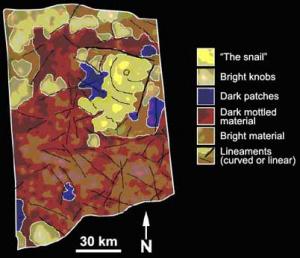 The image of the bright feature now interpreted as a volcanic dome comes from a broader image that covers an area 150 kilometers square; it was obtained by the visual and infrared mapping spectrometer (VIMS) instrument aboard the spacecraft. The overlapping of materials from an evident series of outflows resembles volcanic activity found not only on Earth but on Venus as well.
Image: This geologic map shows that the circular feature has what appear to be several series of flows, as shown by the black lines. The flows represent episodes of activity on the volcano. A dark central pit, called a caldera, is similar to vents that appear above reservoirs of molten material on Earth’s volcanoes. The colors on the map represent the brightness of features. Yellow and light green represent bright patches. Blue represents dark patches. Red represents mottled material. The yellow area is where the volcano lies. Credit: NASA/JPL/University of Arizona.
From a Jet Propulsion Laboratory news release:
In the center of the area, scientists clearly see a dark feature that resembles a caldera, a bowl-shaped structure formed above chambers of molten material. The material erupting from the volcano might be a methane-water ice mixture combined with other ices and hydrocarbons. Energy from an internal heat source may cause these materials to upwell and vaporize as they reach the surface. Future Titan flybys will help determine whether tidal forces can generate enough heat to drive the volcano, or whether some other energy source must be present.
Other explanations could cover this surface feature, among them a cloud (unlikely because it does not appear to move) or an accumulation of solid particles along the lines of a sand dune on Earth, with material pushed by a gas outflow or a liquid. But neither explanation seems as likely as volcanic activity. Moreover, the data (drawn from the first targeted Titan flyby on Oct. 26, 2004) seem solid. The visual and infrared mapping spectrometer detects 352 wavelengths and measures the intensities of each to infer the composition and other properties of what it finds on the surface.
The paper is Sotin, Jaumann et al., “Release of volatiles from a possible cryovolcano from near-infrared imaging of Titan,” Nature 435, 786-789. Also of interest in the June 9 Nature is the article “Planetary Science: Shades of Titan,” by Louise Prockter.


Titan’s Ice Volcanoes Might Produce Stuff of Life
By John Ruley
Astrobiology Magazine
posted: 14 August 2008, 06:50 am ET
For almost thirty years, scientists have known that complex carbon compounds called tholins exist on comets and in the atmospheres of the outer planets. Theoretically, tholins might interact with water in a process called hydrolysis to produce complex molecules similar to those found on the early Earth.
On the Earth, complex organic molecules are believed to have been an early step in the emergence of life; such compounds are called prebiotic.
Titan, the sixth and largest moon of the planet Saturn, is thought to be made largely of ice. Some of that ice may melt during meteor impacts or in underground processes, producing “ice volcanoes” that emit a “lava” containing ammonia mixed with water.
Could tholins formed in Titan’s atmosphere react with liquid water temporarily exposed by meteor impacts or ice volcanoes to produce potentially prebiotic complex organic molecules — before the water freezes? Until this year, no one knew.
Full article here:
http://www.space.com/scienceastronomy/080814-am-titan-tholins.html