
Apropos to our earlier discussion about shielding an interstellar probe comes this new image from the Hubble Space Telescope (click to enlarge). This chaotic and expanding mass of gas and dust, known as LMC N 63A, is the result of the explosion of a massive star. It’s found in the N 63 region of the Large Magellanic Cloud, an irregular galaxy 160,000 light years from the Milky Way that is visible in the southern hemisphere.
Numerous studies have been made of star formation and supernova remnants in this region. Imagine the shielding requirements that would be needed to penetrate such a active patch of sky! Fortunately, the interstellar medium is rarely so dense, but images like these remind us that space is anything but empty. Instead, it houses to a greater or lesser extent gas and dust particles that have to be reckoned with.
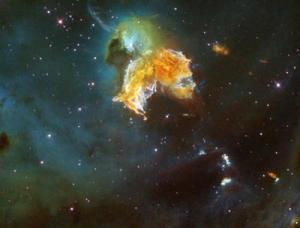 We’ve also looked recently at the growing evidence that Voyager 1 is at the edge of the heliosphere, that ‘bubble’ of relatively clear space blown by the Sun’s solar winds as they clear away the near-Sun region within which the planets lie. A star like the supernova remnant here would have had huge stellar winds — the star is estimated to have been perhaps 50 times more massive than the Sun — and the supernova explosion that destroyed it would have taken place deep within a heliosphere carved out of a clumpy, gas-filled region in this star-forming area.
Image: The Hubble image of N 63A is a color representation of data taken in 1997 and 2000 with Hubble’s Wide Field Planetary Camera 2. Color filters were used to sample light emitted by sulfur (shown in red), oxygen (shown in blue), and hydrogen (shown in green). Credit: NASA, ESA, HEIC, and The Hubble Heritage Team (STScI/AURA). Acknowledgment: Y.-H. Chu and R. M. Williams (UIUC).
The photograph is an interesting study of how stars are born. Remnants like this one are thought to trigger star formation when the expanding shock waves they generate run into interstellar gas. But because N 63A is still a young object, its shock wave is so strong that it disrupts and destroys nearby gas clouds instead of causing them to collapse and form a new generation of stars. You have to go out ten to fifteen light years from N 63A to find the nearest stellar nursery.
Current theories suggest that in several million years, when the ejecta from N 63A finally reach this distance, a round of planetary formation around the young suns may be triggered. And there is every reason to believe that this process parallels what happened in our own Solar System.

Spectral Identification of an Ancient Supernova using Light Echoes in the LMC
Authors: A. Rest, T. Matheson, S. Blondin, M. Bergmann, D. L. Welch, N. B. Suntzeff, R. C. Smith, K. Olsen, J. L. Prieto, A. Garg, P. Challis, C. Stubbs, M. Hicken, M. Modjaz, W. M. Wood-Vasey, A. Zenteno, G. Damke, A. Newman, M. Huber, K. H. Cook, S. Nikolaev, A. C. Becker, A. Miceli, R. Covarrubias, L. Morelli, G. Pignata, A. Clocchiatti, D. Minniti, R. J. Foley
(Submitted on 30 Jan 2008)
Abstract: We report the successful identification of the type of the supernova responsible for the supernova remnant SNR 0509-675 in the Large Magellanic Cloud (LMC) using Gemini spectra of surrounding light echoes. The ability to classify outbursts associated with centuries-old remnants provides a new window into several aspects of supernova research and is likely to be successful in providing new constraints on additional LMC supernovae as well as their historical counterparts in the Milky Way Galaxy (MWG). The combined spectrum of echo light from SNR 0509-675 shows broad emission and absorption lines consistent with a supernova (SN) spectrum.
We create a spectral library consisting of 26 SNe Ia and 6 SN Ib/c that are time-integrated, dust-scattered by LMC dust, and reddened by the LMC and MWG. We fit these SN templates to the observed light echo spectrum using $\chi^2$ minimization as well as correlation techniques, and we find that overluminous 91T-like SNe Ia with $\dm15 less than 0.9$ match the observed spectrum best.
Comments: 12 pages, 18 Figures, to be published in ApJ
Subjects: Astrophysics (astro-ph)
Cite as: arXiv:0801.4762v1 [astro-ph]
Submission history
From: Armin Rest [view email]
[v1] Wed, 30 Jan 2008 21:02:06 GMT (2308kb)
http://arxiv.org/abs/0801.4762