
Big mirrors make all the difference in optical astronomy. A 100 meter telescope (compensating for atmospheric disturbances) could separate two points on the moon two meters apart. Compare that to the 95 meters the Hubble Space Telescope can resolve and you can see that there is a case for Earth-based optical searches for planets around other stars.
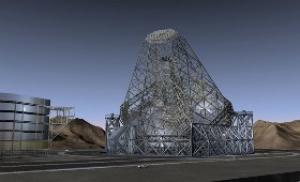 But how do we build such gigantic mirrors? Today’s most advanced designs — 8 to 10-meter instruments — are created around mirrors that were constructed from smaller mirror segments. They use computers to achieve the needed fine-tuning so that the mirrored parts act like a single surface. Stepping this technology up to the 100-meter level, as astronomers in Europe are now discussing, would open up the search for terrestrial worlds around hundreds of nearby stars. As examined earlier in these pages, a 100-meter telescope should be able to detect Earth-like planets around stars as far as 100 light years away, a sphere containing some 1000 Sun-like stars.
Image: An artist’s conception of OWL, the Overwhelmingly Large Telescope, now under consideration as part of the broader design study for ELTs. Credit: European Southern Observatory.
The scientific case for such an Extremely Large Telescope (ELT) was made at a meeting in the Netherlands yesterday, initiating the design phase of the project. The study that will emerge from this work will define the enabling technologies behind the ELT. The study will be led by the European Southern Observatory, with funding from a European-wide consortium of partners, as discussed in a news release from the UK’s Particle Physics and Astronomy Research Council (PPARC). A report from the study is due in 2008, and some believe the ELT could be functional as early as 2015.
And here’s an interesting twist: a prime goal for ELT researchers is to be an examination of the earliest stars in the universe. Although the first stars would be not visible even to an instrument of this size, it is possible that supernovae explosions from these stars might be. Such explosions could serve as so-called ‘standard candles’ that help to measure the size of the universe, and may prove useful in our investigations of the mysterious ‘dark energy’ that seems to pervade the cosmos.
You can view the science case documents for an Extremely Large Telescope, as presented yesterday in the Netherlands, here. Note in particular this telling point about plucking a terrestrial world out of the neighboring starshine:
Careful study of the telescope design and performance of adaptive optics systems are needed. However, initial studies of the expected point spread function and exo-planet detectability limits look very promising. Apart from the sheer collecting area of an ELT (which is needed to study such faint planets), the main advantage of larger telescope size is that the image of the central star can be made sharper (i.e. the diffraction limit is smaller), giving cleaner separation between the star and its faint companion planets. This is one of the main drivers towards the largest telescope size possible.

0 Comments