
What on Earth (or off it) is an Optical Delay Line (ODL)? It turns out to be, according to the European Space Agency, “…a sophisticated opto-mechanical device that can introduce well-defined variations, or delays, in the optical path of a light beam…” And it’s a key player in the technique known as nulling interferometry, which ESA’s Darwin mission will use to dampen the glare of distant stars while exposing the light of their planets. Darwin will be a multi-satellite mission using multiple orbiting telescopes working together to produce a much larger effective aperture than any one of them can muster.
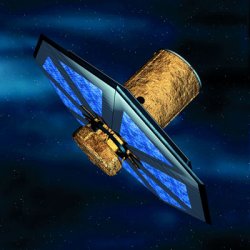
As to that ODL, the optical delay it introduces has to be able to adjust the path of a beam of light with an accuracy measured in just a few nanometers (billionths of a meter). To achieve this, the agency is testing a design using magnetic levitation to control its mirror, a contactless and frictionless method ESA likens to the touch of a feather (a video clip is available). What’s more, the device has been tested at -233 Celsius, a cryogenic temperature demanded by the need to reduce interference from the satellites’ own thermal radiation. This is crucial because Darwin will operate at infrared wavelengths.
Image: One of Darwin’s telescopes, due to be part of a flotilla of four or five free-flying spacecraft. Credit: ESA 2002
Why infrared? Because the difference in brightness between star and planet is minimized at mid-infrared wavelengths. Assuming the ODL design (or its successor) functions as planned, Darwin will recombine the light from its separate telescopes aboard a hub spacecraft, and we may eventually be examining exoplanets and their atmospheres for signs of oxygen, carbon dioxide and other potential life-markers.
The target: Some 1000 of the closest stars and the small, rocky planets assumed to circle at least some of them. Orbiting from the L2 point 1.5 million kilometers from Earth, Darwin’s spectrometers could give us some of the most exciting data ever received in the exoplanet hunt, though just when it will launch is still a matter for conjecture.

ummm… a nanometer is 10^-9 meters, not 10^-6; that’s a micrometer.
Whoops, glad you spotted that. I’ll fix it right away. For those who see only the amended version, I had mistakenly referred to a nanometer as a ‘millionth’ of a meter instead of a billionth.
DARWIN mission proposal to ESA
Authors: Alain Leger, Tom Herbst, et al
(Submitted on 23 Jul 2007)
Abstract: The discovery of extra-solar planets is one of the greatest achievements of modern astronomy. There are now more than 200 such objects known, and the recent detection of planets with masses approximately 5 times that of Earth demonstrates that extra-solar planets of low mass exist. In addition to providing a wealth of scientific information on the formation and structure of planetary systems, these discoveries capture the interest of both scientists and the wider public with the profound prospect of the search for life in the Universe. We propose an L-type mission, called Darwin, whose primary goal is the study of terrestrial extrasolar planets and the search for life on them. By its very nature, Darwin advances the first Grand Theme of ESA Cosmic Vision. Accomplishing the mission objectives will require collaborative science across disciplines ranging from planet formation and atmospheres to chemistry and biology, and these disciplines will reap profound rewards from their contributions to the Darwin mission.
Comments: This a compressed version of the DARWIN mission proposal to ESA for its “Cosmic Vision” 2015-2025 program A full resolution version can be obtained from the Web site indicated on the cover page
Subjects: Astrophysics (astro-ph)
Cite as: arXiv:0707.3385v1 [astro-ph]
Submission history
From: Alain Leger [view email]
[v1] Mon, 23 Jul 2007 14:21:16 GMT (973kb)
http://arxiv.org/abs/0707.3385