
New Horizons’ recent encounter with Jupiter seems to have gone off flawlessly, returning stunning imagery in the bargain. For the Pluto-bound spacecraft, the giant planet turned out to be more than a simple gravitational slingshot. Jupiter was also a shakedown for the even more intriguing planetary encounter to come in 2015, letting both spacecraft systems and operators here on Earth work through a real-time event.
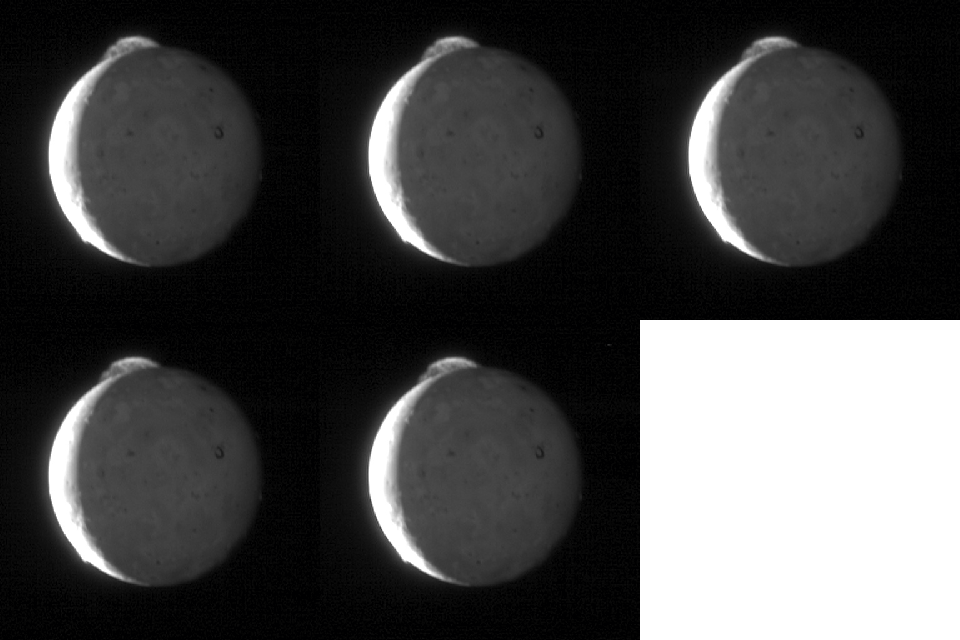
This image of the moon Io, showing a volcanic eruption in progress on that tortured world, was only one of many scenes the spacecraft captured (including excellent views of Jupiter’s rings). If you look at the Io picture carefully, you can see another plume, from the volcano Masubi at about the 7 o’clock position. On the nightside, the volcano Loki is visible as illuminated by Jupiter. The images that went into this animation were taken over an eight-minute span on March 1.
Image: This five-frame sequence of New Horizons images captures the giant plume from Io’s Tvashtar volcano. Snapped by the probe’s Long Range Reconnaissance Imager (LORRI) as the spacecraft flew past Jupiter earlier this year, this first-ever “movie” of an Io plume clearly shows motion in the cloud of volcanic debris, which extends 330 kilometers (200 miles) above the moon’s surface. Only the upper part of the plume is visible from this vantage point – the plume’s source is 130 kilometers (80 miles) below the edge of Io’s disk, on the far side of the moon. Credit: NASA/Johns Hopkins University Applied Physics Laboratory/Southwest Research Institute.
36 gigabits of data in all were gathered between February 24 and March 7. With the Jupiter data download now complete, New Horizons now speeds on for its meeting with Pluto and Charon. “…we’ve seen some amazing things,” says New Horizons Project Scientist Hal Weaver (Johns Hopkins University Applied Physics Laboratory). “It’s fair to say we met or surpassed nearly all of our scientific objectives.” All of which bodes well for the next encounter, one with even more riding on its outcome as we get our first close-up of Pluto and move out into the Kuiper Belt.


MOONS OF JUPITER: Jupiter’s moons are so big, their details
are visible from backyards on Earth.
Mike Salway of Central Coast, Australia, used a 12-inch
Newtonian reflector to take these pictures of Ganymede
and Io on May 26th:
http://www.spaceweather.com/swpod2007/05jun07/Mike-Salway-20070526-Gany%2BIo_1180994876.jpg
“To me, the surface markings are unmistakably real,”
says Salway. “In moments of great seeing, especially with
Ganymede which is bigger than the planet Mercury, the
features were seen in [individual video frames].”
“I believe the egg shape of Io is due to darkened polar regions.
The camera isn’t sensitive enough to detect these dark regions
against the black of space. When Io transits Jupiter, however,
you can see the dark poles against the obviously bright planet.”
This is a great week to observe Jupiter’s moons, and Jupiter
itself, because the giant planet is at its closest to Earth for all
of 2007. Stay tuned for more information.
EXTRA: On May 11th, Salway recorded a fantastic movie of
Jupiter and its largest moons. Expand your browser and click
here. (770 kb)
http://www.spaceweather.com/swpod2007/05jun07/20070511-jupiter_anim.gif