
While we wait for the last transit of Venus of the century, it’s worth remembering how tricky transit studies can be when we push them out to exoplanetary distances. You would think that catching a transit of a planet like Venus, closer to us than the Sun, would be simplicity itself, but the orbital planes of Venus and the Earth are not precisely enough aligned to allow for more than a pair of transits followed by over a century of waiting for the next. I’ve just received a copy of Mark Anderson’s The Day the World Discovered the Sun (Da Capo Press, 2012) and will be writing about 18th Century transit studies and their impact in coming weeks.
The transits Anderson writes about and the expeditions that ranged the globe to study them played a role in helping astronomers understand the dimensions of the Solar System. And you can see that if Venus is a challenge, tracking planets around other stars will push our technology to its limit. Nonetheless, we’re getting quite good at teasing information out of our data, as the planet known as HD 189733b continues to show us. It was just 16 months ago that carbon dioxide and methane were discovered in the planet’s atmosphere. Moreover, the work was done using a 3-meter instrument located at NASA’s Infrared Telescope Facility at Mauna Kea that ranks no higher than 40th among our ground-based instruments.
Sodium had already been found in the atmosphere of HD 189733b, and now comes word that astronomers working at the Hobby-Eberly Telescope at UT Austin’s McDonald Observatory have identified interactions with the parent star that show the planet is slowly dissolving. 63 light years away in the constellation Vulpecula, the planet is losing hydrogen in great streamers that are much hotter than previously thought, an indication that flare activity on the star is interacting with the atmosphere of the planet. Given the proximity of planet to star, that’s not entirely surprising: HD 189733b, a ‘hot Jupiter,’ orbits 10 times closer to its star than Mercury to our Sun.
Probing an exoplanet’s atmosphere is made possible by its transits as seen from Earth, as Seth Redfield (Wesleyan University) explains:
“Each time the planet passes in front of the star, the planet blocks some of the star’s light. If the planet has no atmosphere, it will block the same amount of light at all wavelengths. However, if the planet has an atmosphere, gases in its atmosphere will absorb some additional light.”
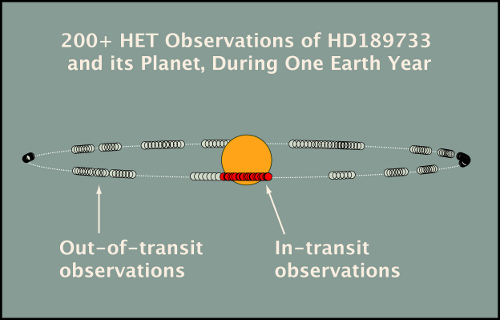
Image: The dotted line shows the planet’s orbit around the star HD189733. The planet orbits the star once every 2.2 Earth days, crossing the face of the star well below its equator. The small circles indicate the planet’s location during each of Seth Redfield’s more than 200 Hobby-Eberle Telescope observations over the course of one Earth year. The red circles indicate observations during transit; the rest of the circles denote out-of-transit observations. Credit: S. Redfield/T. Jones/McDonald Obs.
It was Redfield who first identified sodium in HD189733b’s atmosphere using the same instrument, based on observations that compared the spectrum of the light collected during a transit with the light of the star by itself. As huge as this planet is — 20 percent more massive than Jupiter — it blocks only 2.5 percent of the star’s light, along with another 0.3 percent that is accounted for by the planet’s atmosphere. Exoplanetary atmosphere studies using transits are built around the slight differences that are revealed when the planet passes in front of the star. It’s worth reflecting on all this as we wait for tomorrow’s transit of Venus and ponder how far transit studies have taken us since the first scientific expeditions set out to study them.
The paper is Jensen et al., “A Detection of Hα in an Exoplanetary Exosphere,” Astrophysical Journal Vol. 751, No. 2 (2012), p. 86 (abstract / preprint). More in this McDonald Observatory news release.

Speaking of the Venus Transit and exoplanets:
Scientists to Use Venus Transit to Hone Alien Planet Search Techniques
by SPACE.com Staff
Date: 03 June 2012 Time: 07:00 AM ET
http://www.space.com/15977-venus-transit-alien-planet-search.html
And here is a review of another book on the Venus Transit and its history (Chasing Venus is yet another new one on the subject to check out):
http://www.thespacereview.com/article/2091/1
Paul – Thank you for that note about Anderson’s new book on the Venus transit history, I was not aware of it. I bet it will be on sale starting June 6. :^)
This will remind me of what happened to all those books that came out about Comet Halley just before its last visit in 1986. At least unlike the next Venus Transit I will have a slim chance of actually seeing Halley again in 2061 – though they say it won’t be spectacular looking in Earth’s skies again until the next appearance in 2134.
Is it possible some of light might also be reradiated at a different wavelength? Why is our sky bluish when our sun is redish? Why does earth emit in long wave while the sun emits in short wave? What phenomenom accounts for the differences of scale between ones planets emissions versus ones stars emission aside from temperature differences? Does the surface of a planet not absorb radiative pressures from it’s host stars emissions? Maybe I’m missing something or this articles over-simplification leaves something more to be desired with respect to our current understanding of planetary phenomena?
Some great images of the Venus Transit of 2012 from Mount Hamilton via the systemic Web site:
http://oklo.org/2012/06/06/11-december-2117/
http://oklo.org/2012/06/05/once-in-a-lifetime/
Parallax Effect Charted in the 2012 Transit of Venus
by Nancy Atkinson on September 28, 2012
Back in the 18th century, astronomers were trying to determine the distance from the Earth to the Sun. They used the parallax method during the Transits of Venus the 1760s to help answer that question, and their results provided a cosmic measuring stick that has allowed astronomers to measure distances in the Universe.
How did that method work? New images and movies of the transit of Venus on June 6, 2012 which compare event from two different locations on Earth clearly show the parallax effects that have made Venus transits so important historically.
Full article here:
http://www.universetoday.com/97631/parallax-effect-charted-in-the-2012-transit-of-venus/
To quote:
Colin Wilson, Operations Scientist for Venus Express, said, “Planetary transits are not just of historical interest, they have acquired a new importance in the study of newly discovered planets around other stars. Because we cannot image exoplanets directly, it is only by studying their transits that we can discover whether they harbour liquid water or other potential ‘biomarker’ molecules like methane or ozone. The Venus transit is an example much closer to home, offering us a chance to test our understanding of how to interpret transit data. This certainly added extra interest as we watched the Venus transit in June – particularly knowing it was our last chance that we’d have to wait until 2117 to see the next one!”