
Hubble Makes ‘Movie’ of Neptune’s Atmosphere

by | Sep 5, 2005 | Missions, Outer Solar System | 1 comment

The Hubble Space telescope used 14 different color filters to dig out the details of different layers in Neptune’s atmosphere, showing the haze and clouds in considerable detail, and producing a time-lapse movie that has now been released on the Internet. In the image below (click to enlarge), a natural color view of Neptune appears on the left; the familiar blue-green of the atmosphere is the result of absorption by methane of the red wavelengths striking the planet.
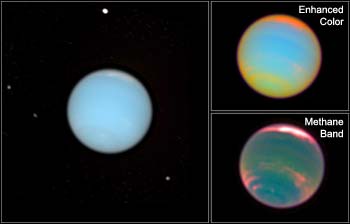
At upper right is an enhanced color view. But now check the view at bottom right, taken using methane filters that bring out details above the bulk of the atmospheric methane. At these wavelengths, the planet appears much darker and the long exposure times this permits help to reveal some of Neptune’s smaller moons. You can see these in the natural color image, which is a composite of images in green, red and blue light.

Clockwise from the top, Proteus is the brightest moon; the others are Larissa, Despina and Galatea. Neptune’s known moons total 13. The length of the Neptunian day is between 14 and 19 hours; the Hubble images (made on April 29 and 30 of this year) were taken every four to five hours, thus spacing them at about a quarter of the planet’s rotational period.

Image credit: NASA, ESA, E. Karkoschka (University of Arizona), and H.B. Hammel (Space Science Institute, Boulder, Colorado).

1 Comment

  1. Wow! Was this really the 2nd post?

Now Reading

Charter

In Centauri Dreams, Paul Gilster looks at peer-reviewed research on deep space exploration, with an eye toward interstellar possibilities. For many years this site coordinated its efforts with the Tau Zero Foundation. It now serves as an independent forum for deep space news and ideas. In the logo above, the leftmost star is Alpha Centauri, a triple system closer than any other star, and a primary target for early interstellar probes. To its right is Beta Centauri (not a part of the Alpha Centauri system), with Beta, Gamma, Delta and Epsilon Crucis, stars in the Southern Cross, visible at the far right (image courtesy of Marco Lorenzi).

Recent Posts

On Comments

If you'd like to submit a comment for possible publication on Centauri Dreams, I will be glad to consider it. The primary criterion is that comments contribute meaningfully to the debate. Among other criteria for selection: Comments must be on topic, directly related to the post in question, must use appropriate language, and must not be abusive to others. Civility counts. In addition, a valid email address is required for a comment to be considered. Centauri Dreams is emphatically not a soapbox for political or religious views submitted by individuals or organizations. Human comments only, please -- cut and paste from AI will not be acceptable. A long form of the policy can be viewed on the Administrative page. The short form is this: If your comment is not on topic and respectful to others, I'm probably not going to run it.


Advanced Propulsion Research

Beginning and End

Archives