
With the Steins encounter looming, let’s keep the focus on the asteroid belt, in this case by examining a connection between that distant region and our own planet. Cosmic dust particles — tiny bits of pulverized rock up to a tenth of a millimeter in size — move continuously through the Solar System, a kind of micro-thin fog of micrometeorites that contributes hundreds of billions of particles to Earth’s atmosphere. New research into the makeup of some 600 of these particles now reveals their chemical and mineral content, allowing an overview that points to their origin. The suspected source: A group of asteroids between Mars and Jupiter.
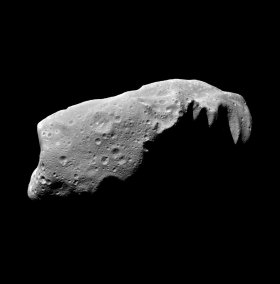
You can see one of the Koronis asteroids in the image at left, which shows 243 Ida as photographed by the Galileo probe. What we now believe about the Koronis asteroids is that they were formed some two billion years ago by the breakup of a much larger asteroid. Within the Koronis family are the ninety or so Karin asteroids, which seem to be in a constant process of smashing into each other to create cosmic dust. Themselves the result of a far more recent collision (pegged at 5.7 million years), the Karin asteroids are useful because they are readily susceptible to spectroscopic analysis.
Image: This view of the Koronis asteroid 243 Ida is a mosaic of five image frames acquired by the Galileo spacecraft’s solid-state imaging system at ranges of 3,057 to 3,821 kilometers (1,900 to 2,375 miles) on August 28, 1993, about 3-1/2 minutes before the spacecraft made its closest approach to the asteroid. Galileo flew about 2,400 kilometers from Ida at a relative velocity of 12.4 km/sec. Credit: NASA/JPL.
Says Matthew Genge (Imperial College London), who studied the micro-meteorites in Antarctic dust:
“I’ve been studying these particles for quite a while and had all the pieces of the puzzle, but had been trying to figure out the particles one by one. It was only when I took a step back and looked at the minerals and properties of hundreds of particles that it was obvious where they came from. It was like turning over the envelope and finding the return address on the back.”
Genge’s micrometeorites contain information about the formation of asteroids and comets some four and a half billion years ago. As with Martian meteorites, the chance to study material from another celestial object without the expense of mounting an expensive mission is itself noteworthy. We’re synchronizing laboratory mineralogy with infrared observations of the Karin asteroids, work with implications for the origin of the Karin group in what seems to have been a rubble-pile asteroid.
The paper is Genge, “Koronis asteroid dust within Antarctic ice,” Geology Vol. 36, Issue 9 (September 2008), pp. 687-690 (abstract).

I’ve always been impressed by spectroscopic studies that pin down asteroid families and their allied meteoritic traces. One thing cosmic dust reveals, especially long term records like sea-bed samples, is that the dust levels are highly variable through time. A few years back one paper showed we were currently in a dust-peak, at about 3 times background levels, and that much higher peaks could be discerned further back in time – up to 6 times background. The sediment core record ends 80 mya, but no doubt the process of supply and loss has oscillated back and forth over billennia. A core sample of a periodic deposit on an axially stable world, like Mercury’s polar caps, might reveal the full collisional history of the last 4 billion years. Unfortunately there’s no plans to visit those caps anytime soon with sufficient coring equipment and analytical laboratories sufficient to the task could be hard to pack into a lander.
I think my favourite meteoroid study is the one that found that there is a significant flux of particles arriving in our solar system from Beta Pictoris, which potentially means we can sample material from an extrasolar system without having to figure out the interstellar travel problem.